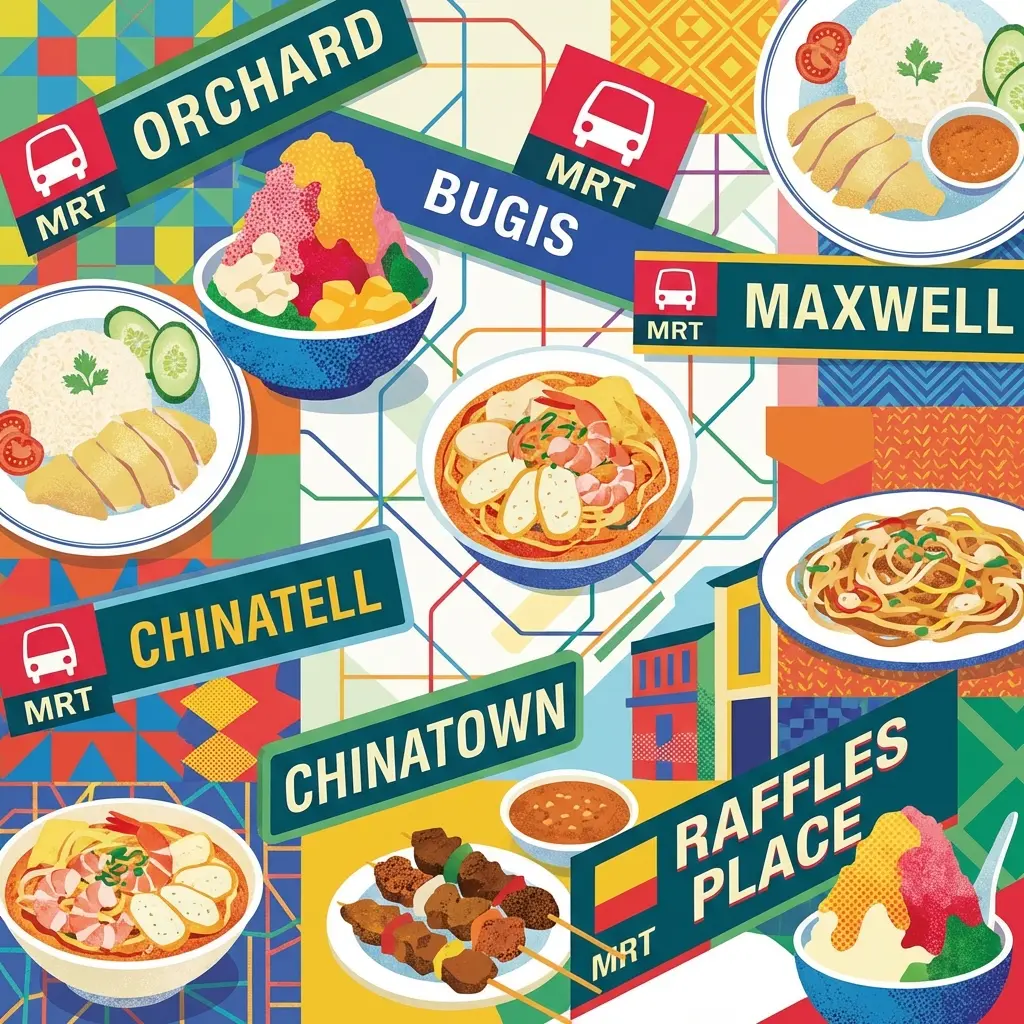
"A hungry commuter's guide to the best food stops. Hop off the train and straight into a queue for something delicious."
Top Hawker Picks by Line
- East-West Line: Tiong Bahru Market (chwee kueh), Old Airport Road (char kway teow)
- North-South Line: Maxwell Food Centre (chicken rice), Toa Payoh Lorong 8 (Hokkien mee)
- North-East Line: Chinatown Complex (200+ stalls), Chomp Chomp (satay)
- Circle Line: Old Airport Road (best overall), Holland Drive (claypot rice)
- Downtown Line: Albert Centre (Teochew porridge), Beauty World (curry puffs)
Why This Guide Exists
Singapore's MRT system isn't just public transport—it's a food delivery network that brings you to the doorsteps of the island's greatest hawker centres. With over 100 hawker centres scattered across the island, knowing which ones are worth a detour can save you from mediocre meals and lead you to life-changing ones.
"Every MRT line tells a different culinary story. The East-West Line whispers of heritage, the Circle Line hums with variety, and the Downtown Line surprises you with hidden gems."
This guide maps out the essential hawker centres along each MRT line, highlighting the must-try stalls and the dishes that have earned legendary status. Whether you're a tourist with three days or a local who's somehow never ventured beyond your neighbourhood, consider this your invitation to eat your way across Singapore, one MRT stop at a time.
The hawker centres listed here were chosen based on proximity to MRT stations (within a 10-minute walk), overall food quality, variety of stalls, and that intangible quality Singaporeans call 'shiok'—the feeling of complete satisfaction that comes from a perfect meal.
East-West Line (Green Line)
The East-West Line is the grande dame of Singapore's food scene, cutting through some of the most storied food neighbourhoods from Pasir Ris to Tuas Link.
Tiong Bahru Market at Tiong Bahru station is the undisputed queen of this line. The market sits in Singapore's oldest public housing estate, and the food matches the heritage. Jian Bo Shui Kueh has been serving silky rice cakes with preserved radish since 1958—the queue starts forming before 7am and the kueh sells out by 10am. Lor Mee 178 nearby serves a gravy so thick and flavourful it borders on addictive.
"Tiong Bahru on a Saturday morning is a rite of passage. The chwee kueh, the lor mee, the crowds—it's chaotic and completely wonderful."
Bedok Interchange Hawker Centre at Bedok station is the east side's answer to everything. The Bak Chor Mee at stall 511 uses hand-made noodles with a vinegar-forward sauce that purists swear by. For something different, 89.7 Supper Ng Ah Sio Bak Kut Teh serves peppery pork rib soup that's become a late-night institution.
Queenstown's ABC Brickworks Food Centre (accessible via Queenstown station) is a neighbourhood gem worth the detour. The curry rice at Heng Heng is legendary—point at whatever catches your eye and let them drown it in curry. The carrot cake here is also exceptional.
Further east, Changi Village Hawker Centre isn't directly on the MRT but is worth the bus connection from Tampines. The Nasi Lemak at stall 1 has been voted among Singapore's best repeatedly, and International serves a mean plate of fried Hokkien mee.
North-South Line (Red Line)
The North-South Line stretches from the tourist heart of Marina Bay to the suburban sprawl of Woodlands, with excellent eating opportunities throughout.
Newton Food Centre at Newton station is the most famous hawker centre among tourists, and while prices are higher than average, the quality justifies it—if you know where to order. Hup Kee Fried Oyster Omelette delivers crispy-edged, egg-wrapped oysters that rival any in the city. Alliance Seafood does excellent BBQ sambal stingray.
"Newton gets a bad reputation for tourist traps, but the old-timers still know where to find honest food at honest prices. You just need to know which stalls to trust."
Toa Payoh Lorong 8 Market at Toa Payoh station is the heartland hero. Kim Keat Hokkien Mee serves a properly charred, wok-hei-laden plate that exemplifies why this dish is so beloved. The rojak stall nearby uses fresh ingredients and homemade paste. This market feels authentically Singaporean—it's where residents have eaten for generations.
Chong Pang Market at Yishun station serves the north admirably. The Nasi Lemak at Selera Rasa Nasi Lemak comes with housemade sambal that's addictively spicy. The chicken rice here is also above average, and the market stays lively well into the evening.
Maxwell Food Centre, while closer to Tanjong Pagar station, is essential to mention. Tian Tian Hainanese Chicken Rice—the stall that put Maxwell on the global map—still serves silky poached chicken over fragrant rice, though the queue can exceed an hour during peak times.
North-East Line (Purple Line)
The North-East Line connects the city to Singapore's northeastern heartlands, passing through some of the most character-rich food destinations.
Chinatown Complex at Chinatown station is Singapore's largest hawker centre, spanning two floors with over 200 stalls. It can feel overwhelming, but therein lies the adventure. Liao Fan Hong Kong Soya Sauce Chicken Rice—the world's cheapest Michelin-starred meal—still draws crowds, though regulars debate whether the quality has held steady. Ann Chin Popiah serves fresh spring rolls assembled to order.
"Chinatown Complex is not a hawker centre—it's a hawker city. You could eat there every day for a year and still discover new favourites."
The second floor houses the cooked food section where you'll find excellent Teochew porridge, traditional pastries, and one of Singapore's best char kway teow stalls. The wet market on the first floor is equally impressive.
Kovan Market at Kovan station is the neighbourhood gathering spot. The Hokkien Mee here is excellent—served on banana leaf with the requisite sambal and lime. The wanton mee is also noteworthy, with springy noodles and char siew that's properly caramelised.
Serangoon Garden Market at Serangoon station (a short walk) is the supper destination. The famous Chomp Chomp Food Centre operates nearby, but the market itself serves excellent satay and BBQ chicken wings well past midnight.
Circle Line (Yellow Line)
The Circle Line lives up to its name by connecting disparate neighbourhoods in a ring, and along the way, it threads through some of Singapore's most beloved hawker destinations.
Old Airport Road Food Centre at Dakota station is consistently ranked among Singapore's top hawker centres—and the ranking is deserved. The concentration of excellent stalls here is unmatched. Dong Ji Fried Kway Teow serves char kway teow with serious wok hei, Lao Fu Zi Fried Kway Teow offers a worthy alternative, and Nam Sing Hokkien Fried Mee has been perfecting their recipe for over 50 years.
"Old Airport Road isn't just a hawker centre—it's a museum of Singapore's culinary heritage, except everything is still alive and cooking."
The rojak at Soon Soon Huat is exceptional, swimming in thick peanut sauce. Xin Mei Xiang Zheng Zong Lor Mee serves a version with braised pork belly that's heartbreakingly good. Whitley Road Big Prawn Noodles—despite the name—has an outlet here serving massive prawns in rich, umami-laden soup.
Holland Drive Market at Buona Vista station is the Holland Village neighbourhood's workhorse. The claypot rice here requires a 30-minute wait but delivers beautifully—crispy rice crust, lap cheong, and perfectly seasoned chicken. It's best enjoyed on a rainy evening.
Harbourfront Centre's Food Republic at HarbourFront station is technically a food court rather than a hawker centre, but it serves excellent versions of local dishes in an air-conditioned environment—useful when the heat becomes unbearable.
Downtown Line (Blue Line)
The Downtown Line is Singapore's newest major line, and it has quietly become an excellent food corridor, connecting established centres with hidden suburban gems.
Albert Centre at Bugis station is a two-floor food haven. The first floor houses the wet market while the second floor serves breakfast through dinner. Heng Long Teochew Porridge serves silky rice porridge with an array of braised dishes, steamed fish, and preserved vegetables. The Thunder Tea Rice (Lei Cha) here is one of the city's best versions of this Hakka specialty.
"Albert Centre is where the old Bugis—before the gentrification, before the malls—still lives. The food remembers what this neighbourhood used to be."
Beauty World Food Centre at Beauty World station is a rooftop gem that most tourists never find. The view isn't spectacular, but the food is. The curry puff stall serves fresh-from-the-fryer pastries with flaky crusts and curry potato filling. The ban mian is handmade daily.
Bukit Panjang Hawker Centre at Bukit Panjang station serves the western heartlands admirably. It's a newer centre, cleaner and more organised than the heritage markets, but the food quality is high. The prawn noodle soup here is excellent, and the economic rice stall offers great variety.
Farrer Park's Tekka Centre (a short walk from Little India station on the Downtown Line) deserves mention for its incredible Indian food. The biryani, the murtabak, the teh tarik—everything here transports you.
Thomson-East Coast Line (Brown Line)
Singapore's newest MRT line is still expanding, but the stations already operational have unlocked some excellent hawker access.
Woodlands Hawker Centre near Woodlands station serves Singapore's northern frontier. The nasi padang here is exceptional—rice with an array of Malay dishes from beef rendang to sambal goreng. The fish soup is another standout, with fresh fish in clear, peppery broth.
"The north is finally on the MRT map, and the food has been waiting patiently for the rest of Singapore to discover it."
Founders' Bak Kut Teh has an outlet in the area, serving the peppery Teochew-style pork rib soup that defines Singapore's version of this dish.
As the line extends, expect more hawker centres to become accessible. The stations serving the Marine Parade and East Coast areas will eventually connect to Marine Parade Food Centre—home to legendary katong laksa and satay bee hoon.
Interchanges: Where Lines and Flavours Converge
MRT interchange stations offer unique opportunities—you're connected to multiple lines and often multiple excellent hawker centres.
Jurong East interchange connects the East-West and North-South lines near Yuhua Market and Hawker Centre. This humble centre is a locals' favourite with excellent fishball noodles and char kway teow. The proximity to the interchange makes it perfect for a meal during a transfer.
"Interchange stations are like hawker portals—step off at Bishan and you're three stops from anywhere, but the food right here might make you forget where you were going."
Bishan interchange connects the Circle and North-South lines near Bishan North Shopping Mall's food centre. While not a traditional hawker centre, the food court here serves reliable versions of local favourites with the convenience of air conditioning.
Serangoon interchange connects the Circle and North-East lines, putting you within reach of Chomp Chomp and Serangoon Garden Market. The concentration of food options here makes it one of Singapore's great food interchange hubs.
Strategic Eating: Planning Your Hawker Crawl
The true hawker enthusiast doesn't just eat—they strategise. Here's how to maximise your MRT-enabled food adventures.
Start early for breakfast at Tiong Bahru (7:30am for chwee kueh before the queue explodes), then take the East-West Line to Bedok for a mid-morning bak kut teh if you're feeling adventurous. By lunch, circle back via the Circle Line to Old Airport Road for char kway teow.
"A good hawker crawl is like a symphony—you build from light to heavy, breakfast to supper, allowing each dish its moment without overwhelming the palate or the stomach."
For a heritage-focused day, start at Chinatown Complex in the morning, MRT to Maxwell Food Centre for chicken rice lunch, then end at Old Airport Road for dinner. You'll have eaten through decades of Singapore's food history.
For first-time visitors to Singapore, the essential hawker trilogy is: Maxwell (for chicken rice and history), Old Airport Road (for variety and quality), and Chinatown Complex (for scale and adventure).
Carry tissues—they're table reservations and napkins in one. Have small cash for places that don't take cards. And most importantly, approach with an open mind and an empty stomach. The MRT will take you there; the food will make you want to stay.