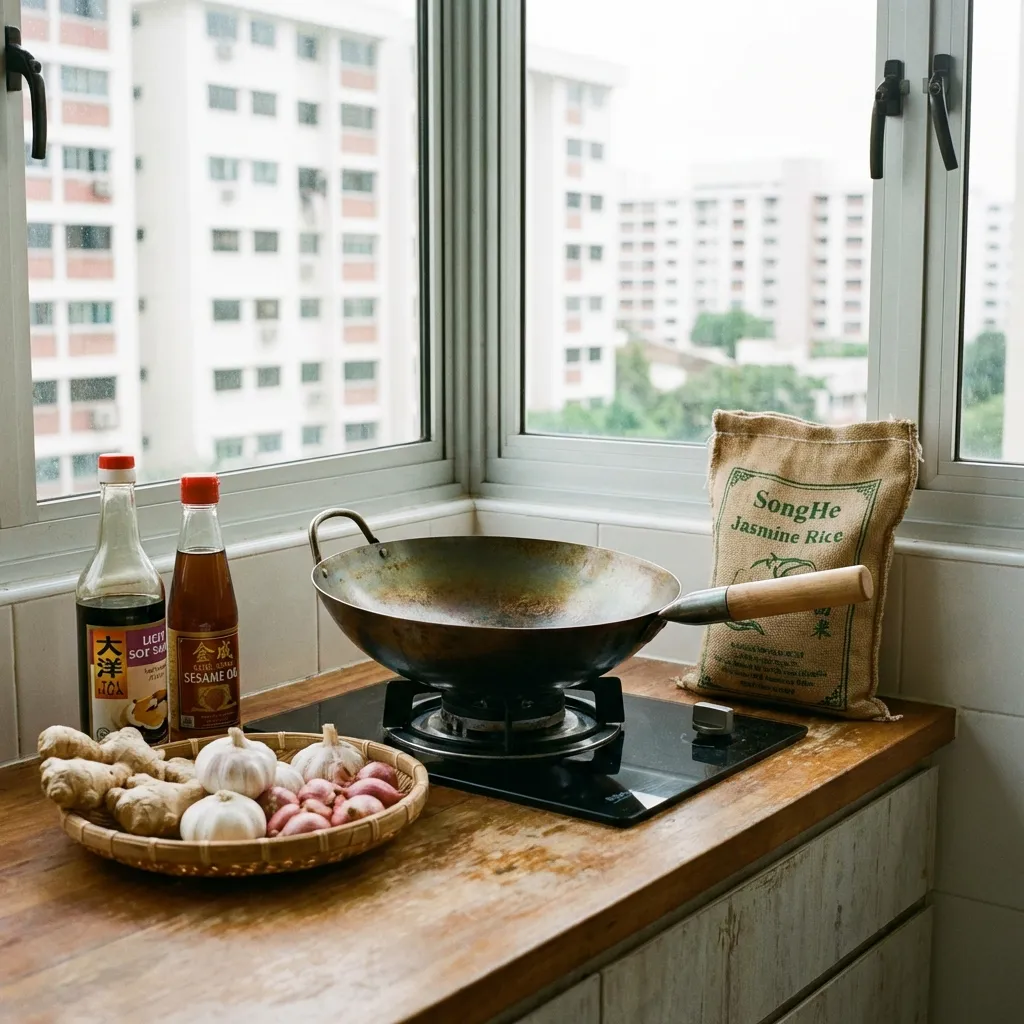
Home Cooking 101: Getting Started in Your Singapore Kitchen
"Setting up your first kitchen? Moving into a new BTO? Here's the no-nonsense guide to the pantry staples, equipment, and mindset you actually need to start cooking Singaporean food at home."
Starting From Zero
- 1 Three sauces handle 90% of dishes: light soy, dark soy, and oyster sauce
- 2 Fresh aromatics (garlic, ginger, shallots) are non-negotiable—skip the powdered versions
- 3 A rice cooker is your first appliance investment—it frees you to focus on everything else
- 4 Start simple: perfect your rice, then fried rice, then vegetables. Build from there
- 5 Every mistake is a lesson. Burnt garlic costs 50 cents. Keep trying
Beginner's Pantry Checklist
The Absolute Beginner's Mindset
Let's get one thing straight: you don't need to be talented to cook well. You need practice, patience, and the right foundation. Every single auntie who cooks effortlessly today once stood in front of her first wok, terrified of burning everything. The difference between her and someone who never learns is simply that she kept trying.
The Singapore kitchen is uniquely forgiving for beginners. Unlike French cuisine with its precise techniques or Japanese cooking with its exacting standards, our home cooking tradition is built on adaptability. Too salty? Add water. Too bland? More soy sauce. Burned the garlic? Start over—it's just garlic. The ingredients are cheap, the techniques are intuitive, and the flavours are bold enough to mask small mistakes.
"My first time cooking, I catch the kitchen fire," laughs now-expert home cook Mrs. Lim. "My mother say, 'Aiyah, at least now you know what NOT to do.' That's the attitude—every failure teaches something."
Start with dishes that are hard to mess up: fried rice, instant noodles upgraded with vegetables, or scrambled eggs. Build confidence before tackling complex recipes.
Cook the same dish three times before judging your ability. The first time is chaos, the second is learning, the third is understanding. By the fourth, you'll have opinions about how to improve it.
The Sticky Situation: Choosing Rice
Rice is the foundation of every Singapore meal. Get this right, and you're 50% of the way to a satisfying dinner. Get it wrong, and nothing else matters—dry, clumpy, or mushy rice drags down the entire meal.
For everyday cooking, Thai Jasmine Rice is the gold standard. Brands like Royal Umbrella and Golden Phoenix consistently deliver fluffy, fragrant grains. The aroma when you lift the rice cooker lid is unmistakable—floral, slightly sweet, intensely comforting.
But not all dishes call for jasmine. For Hainanese Chicken Rice, you want longer grains that stay separate after cooking with chicken fat. For claypot rice, short-grain varieties develop that coveted crispy bottom. For porridge, broken rice or older rice breaks down more readily into silky congee.
"In the old days, we wash rice seven times," shares Uncle Tan, 70. "Nowadays three times is enough—the processing is cleaner. But you must still wash until the water runs clear, or the rice will be gummy."
Store rice in an airtight container with a few dried bay leaves to prevent weevils—a common problem in Singapore's humid climate.
Let rice rest for 10 minutes after the cooker clicks off. The steam redistributes, resulting in evenly fluffy grains. Fluff with a fork, not a spoon.
The Holy Trinity of Sauces
You can cook 90% of Singaporean dishes with three sauces: light soy sauce, dark soy sauce, and oyster sauce. These form the backbone of our flavour profile—salty, sweet, and umami. Master how they work together, and you've unlocked the fundamental taste of home.
Light Soy Sauce provides saltiness and that characteristic savoury depth. It's thin, amber-coloured, and used generously in marinades, stir-fries, and dipping sauces. Don't confuse 'light' with 'low sodium'—it refers to colour, not salt content.
Dark Soy Sauce is thicker, sweeter, and contributes that beautiful caramel colour to braised dishes and fried rice. Use it sparingly—too much turns everything black and overly sweet. A teaspoon goes a long way.
Oyster Sauce adds glossy richness and deep umami. It's the secret behind that restaurant-quality sheen on stir-fried vegetables and the complex flavour base for many Cantonese-style dishes.
"My daughter ask me why her stir-fry don't taste like mine," recalls Auntie Mei. "I look at her sauces—supermarket house brand, all of them. I tell her: buy Tai Hua for soy, Lee Kum Kee Premium for oyster. The difference is night and day."
Store oyster sauce in the refrigerator after opening. It's prone to mould in Singapore's humidity.
When a recipe just says 'soy sauce' without specifying, it usually means light soy. Dark soy is typically mentioned specifically because of its strong colour impact.
Aromatics Are Everything
Ginger, garlic, and shallots—the holy trinity of Asian aromatics. Fresh is non-negotiable. Powdered versions have their place (long-lasting, convenient), but they cannot replicate the brightness and depth of fresh aromatics properly fried in hot oil.
Garlic forms the base of nearly every stir-fry. Buy whole heads and peel as needed. Pre-minced jarred garlic is convenient but tastes flat and slightly acidic compared to freshly smashed cloves.
Ginger adds warmth, cuts through fishy flavours, and provides a subtle heat that differs from chilli. Old ginger (mature, with papery skin) is more fibrous and pungent—perfect for soups and braised dishes. Young ginger (thin-skinned, pink-tinged) is milder and works better in delicate preparations like steamed fish.
Shallots provide sweetness and a gentler onion flavour than their larger cousins. They're essential for rempah (spice paste), fried until golden for garnishing, and sliced raw for salads.
"At wet market, I squeeze the ginger to check it's firm," advises Auntie Rose. "Soft ginger means it's old, the flavour is weak. Fresh ginger should be hard like stone."
Store ginger in the freezer—it grates more easily frozen, and the texture change doesn't matter for most cooked applications.
When frying aromatics, add them in order of cooking time: shallots first (they're largest and need longest), then garlic, then ginger. This prevents garlic from burning while waiting for shallots to soften.
Beyond the Trinity: Essential Pantry Items
With your sauces and aromatics sorted, these supporting players complete your pantry arsenal:
Sesame Oil - A finishing oil, not a cooking oil. Add a few drops at the end of cooking for nutty fragrance. The Chinese-style toasted version is more potent than the pale Korean variety.
Rice Wine (Shaoxing) - Essential for marinades and deglazing woks. It removes gamey smells from meat and adds subtle sweetness. No need for expensive bottles—cooking-grade works fine.
White Pepper - The secret heat of Teochew and Hokkien cooking. Unlike black pepper, white pepper is subtler and doesn't leave visible specks. It's essential for fishball soup, bak kut teh, and white carrot cake.
Rock Sugar - Used in braised dishes, it creates a cleaner sweetness and shinier glaze than regular sugar. It's the secret to that glossy sheen on soy sauce chicken.
Dried Shrimp (Hae Bee) - Tiny flavour bombs. Soak briefly, then fry until fragrant as a base for countless dishes. Essential for char kway teow, fried rice, and sambal.
"When I first set up kitchen, I buy everything at once," recalls home cook Priscilla. "Waste of money—half expired before I used it. Better to buy what you need for each recipe, build slowly."
Check expiry dates on dried goods at the store. Less popular items sometimes sit on shelves for months.
Store all opened pantry items in airtight containers. Singapore's humidity turns crispy things soggy and accelerates staleness dramatically.
The Wok Question
Do you need a wok? If you have a gas stove, unequivocally yes. A carbon steel wok is cheap ($20-40 at Sia Huat), durable, and conducts heat beautifully. Nothing else can achieve proper wok hei—that smoky, charred flavour that defines the best stir-fries.
But here's the inconvenient truth: most HDB kitchens run on induction or ceramic hobs, and traditional round-bottom woks don't work on flat surfaces. Your options:
Flat-Bottom Carbon Steel Wok - A compromise that works reasonably well on electric stoves. You'll never get true wok hei, but you can get close with high heat and patience.
Heavy-Bottomed Stainless Steel Pan - Better heat retention on induction, though it lacks the sloped sides that make tossing easy. Many professional cooks use these at home.
Cast Iron Skillet - Excellent heat retention and searing capability. Heavy, but nearly indestructible. Great for one-pan dishes.
"My mother used the same wok for 40 years," shares home cook Raymond. "When I moved into condo with induction stove, I nearly cried. But I adapted—you can still cook good food, just differently."
Whatever pan you choose, don't overcrowd it. Better to cook in batches than to steam your ingredients in their own moisture.
If you're on induction but determined to have real wok hei, consider a portable butane stove ($30-50). It's what many home cooks use for serious stir-frying—just ensure proper ventilation.
The Rice Cooker: Your First Appliance
Before you buy any other kitchen equipment, get a rice cooker. This isn't laziness—it's strategy. A rice cooker produces consistently perfect rice every time, freeing your attention and stove space for the dishes that actually need monitoring.
Basic models with a single 'cook' button work fine for white rice. If you eat brown rice, porridge, or multiple-grain varieties, invest in a 'fuzzy logic' cooker that adjusts cooking time and temperature based on what it detects in the pot.
What Size?
- 1.0L - Singles and couples
- 1.5L - Small families (2-3 people)
- 1.8L - Standard families (3-5 people)
- 2.0L+ - Large families or meal preppers
"I know people who cook rice on stove, say rice cooker is waste of money," observes cooking instructor David. "But I also see these people burn the rice regularly, or have to watch the pot constantly. The cooker pays for itself in peace of mind."
The markings inside the pot are guides, not gospel. You may prefer slightly more or less water depending on the rice brand and your personal texture preference. Experiment.
Throw a pandan leaf (knotted) into the pot before cooking. It adds a subtle fragrance that makes even basic rice smell special.
Essential Utensils: The Bare Minimum
You don't need a drawer full of gadgets. These essentials will see you through 95% of Singaporean home cooking:
A Sharp Knife or Cleaver - One good blade beats ten mediocre ones. A Chinese cleaver handles everything from mincing garlic to butchering chicken. If that feels intimidating, a standard 8-inch chef's knife works too.
A Sturdy Chopping Board - Wood or thick plastic, large enough to work comfortably. Avoid glass (ruins knife edges) and thin plastic (warps and slides).
A Spider Skimmer - The wire mesh strainer with a long bamboo handle. Essential for deep-frying, blanching, and fishing things out of hot liquid. Worth far more than its $5 price tag.
A Wok Spatula (Chan) - The shovel-shaped tool designed to scrape the wok's curved surface. Metal for carbon steel woks, silicone or wood for non-stick.
Tongs - Useful for everything from tossing noodles to flipping meat. Choose ones with scalloped edges for better grip.
"My ang moh friend come to my kitchen, ask where my garlic press, my avocado slicer, my egg separator," laughs Mrs. Tan. "I show her my cleaver and say, 'This does all of that.' Simple is better."
Buy a cheap knife sharpener and use it every few weeks. A dull knife is more dangerous than a sharp one—it slips instead of cutting cleanly.
Invest in a proper knife, but save money on the chopping board. A $20 wooden board from IKEA works just as well as a $100 artisanal one.
Your First Week: A Practical Start
Don't try to cook everything at once. Here's a realistic first week for a brand new home cook:
Day 1: Perfect Rice
Just rice. Nothing else. Learn your cooker, find your preferred water ratio, master the fluff. Serve with soy sauce and a fried egg.
Day 2: Stir-Fried Vegetables
Kangkong or chye sim with garlic. Simple, fast, teaches basic wok skills. If you burn the garlic, start over—garlic is cheap.
Day 3: Fried Rice
Use yesterday's leftover rice (essential for proper fried rice). Add egg, whatever vegetables you have, soy sauce. You'll eat this version 500 more times in your life.
Day 4: Instant Noodles, Upgraded
Boil noodles, drain, fry with vegetables, egg, and the flavour packet. Not gourmet, but teaches you that home cooking doesn't need to be complicated.
Day 5: Simple Soup
Boil pork ribs or chicken with ginger and salt. Add vegetables towards the end. Let it simmer while you do other things. Soups teach patience.
"People want to skip to the impressive dishes," notes cooking instructor James. "But the best cooks I know still eat simple fried rice for dinner most nights. Master the basics. The fancy stuff follows naturally."
Clean as you go. Wash the chopping board while the rice cooks, rinse the wok between dishes. A clean kitchen is a calm kitchen.
Take photos of your cooking. It feels silly, but comparing your fried rice from week one to month three is incredibly motivating.
Common Beginner Mistakes
Everyone makes these errors. Knowing them in advance won't prevent them entirely, but it softens the frustration when they happen:
Crowding the Pan
The single most common mistake. Too much food drops the temperature, causing steaming instead of frying. Cook in batches. Your patience will be rewarded with better texture.
Not Heating the Oil Enough
If garlic doesn't sizzle immediately when it hits the oil, the oil isn't hot enough. Wait for the shimmer, that slight rippling on the surface that indicates readiness.
Over-Complicating
Beginners often add too many ingredients, hoping quantity equals quality. Singaporean home cooking is often about restraint—a few flavours done well beats many flavours muddling each other.
Ignoring Preparation
Mise en place—having everything chopped, measured, and ready before you start cooking—feels like extra work until you're frantically searching for the soy sauce while your garlic burns. Prep everything first.
Following Recipes Too Rigidly
Recipes are guidelines, not laws. Your stove is different, your pan is different, your ingredients are different. Learn to taste and adjust, not blindly follow.
"Every mistake is tuition fee," philosophizes home cook Auntie Linda. "Some lessons are cheap—burnt garlic. Some lessons are expensive—undercooked chicken. But all lessons are valuable."
If you're unsure whether meat is cooked, cut into the thickest part and check. Better an ugly but safe dinner than food poisoning.
Keep a notepad in the kitchen. When something goes wrong (or right), write it down. After a year, you'll have your own personalised cookbook of lessons learned.
Ready for the next step?
Master the 10 dishes every Singaporean home cook should know.
10 Essential Dishes