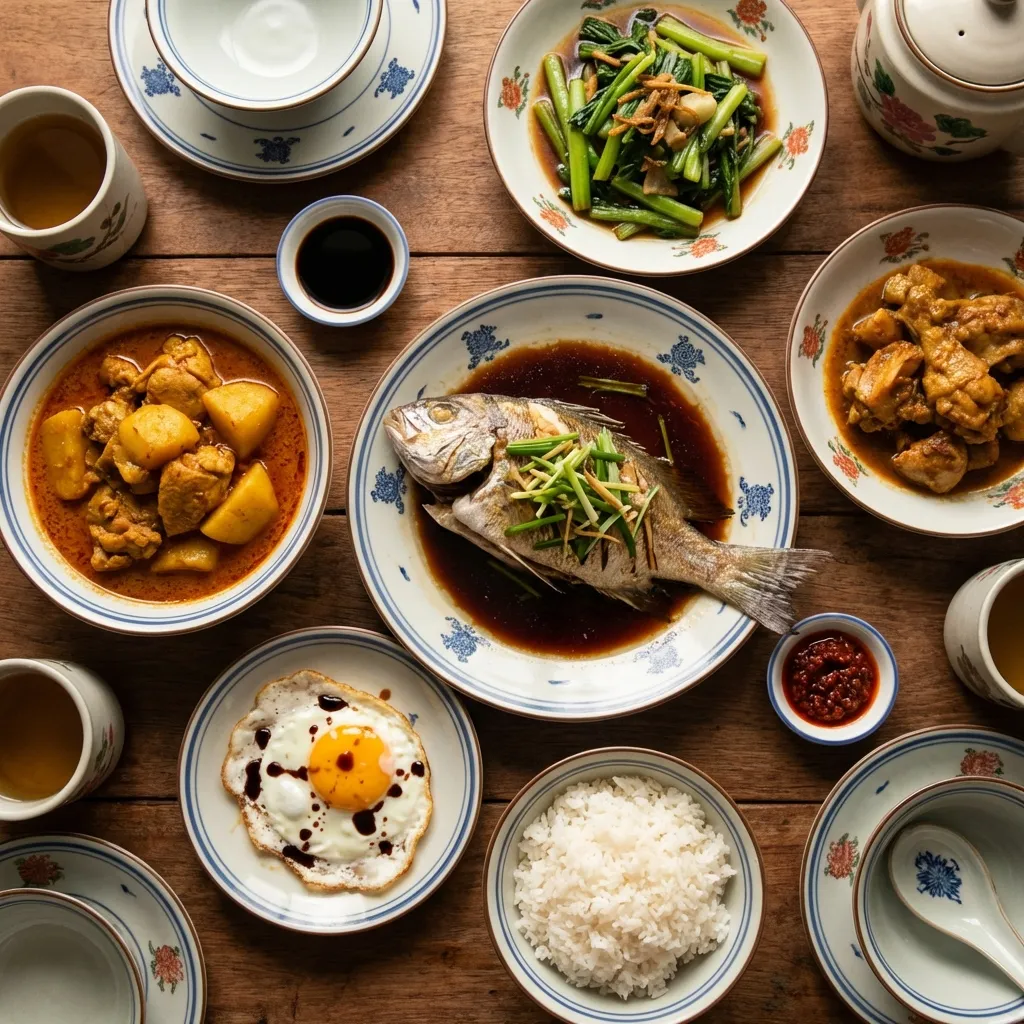
10 Favourite Dishes Every Singaporean Home Cook Should Master
"From the humble fried egg with dark sauce to the celebratory curry chicken, these are the cornerstones of our culinary heritage. Master these, and you'll never need to order delivery again."
Master These Fundamentals
- 1 These 10 dishes cover quick weeknight meals, slow-cooked projects, and celebration centrepieces
- 2 The fried egg teaches heat control; steamed fish teaches timing; curry teaches spice management
- 3 Don't rush—learn one dish per month until it becomes instinctive
- 4 Technique matters more than recipes: 'pecah minyak' for curries, double-fry for crunch, proper rest for meat
- 5 Keep a cooking journal to track what works for your kitchen and your palate
Why These 10 Dishes?
Walk into any Singaporean home at dinnertime, and you'll likely find one of these dishes on the table. They're not the fanciest or most impressive recipes—they're better than that. They're the dishes that define us, passed down through generations, adjusted to each family's taste, and cooked from memory rather than measurement.
These 10 dishes represent the full spectrum of Singaporean home cooking: quick weeknight dinners, slow Sunday projects, sick day comfort, and celebration centrepieces. Master them all, and you've essentially earned your Home Chef certification.
"My mother never gave me recipes," recalls veteran home cook Auntie Mei, 68. "She just said, 'Watch and remember.' That's how we learned—standing next to the stove, absorbing the timing, the sounds, the smells."
Don't try to learn all 10 at once. Pick one dish per month, cook it repeatedly until it becomes second nature, then move on. By the end of the year, you'll have a repertoire that rivals any kopitiam.
1. The Perfect Fried Egg with Dark Sauce
It sounds almost embarrassingly simple, but getting this right separates the cooks from the non-cooks. The goal: crispy, lacy edges with a runny yolk, drizzled with premium dark soy sauce and a whisper of white pepper. It's breakfast, lunch, dinner, and midnight snack material.
The secret is high heat and enough oil. Many home cooks are too timid with oil, resulting in flat, rubbery eggs. You want at least two tablespoons of oil, smoking hot, so the egg puffs and sizzles the moment it hits the pan. The edges should turn golden and crispy within seconds while the yolk stays gloriously runny.
"My ah ma used to fry eggs in pork lard," shares Mr. Koh, 52. "The flavour was incredible—nothing like vegetable oil. Once a year, for old time's sake, I still do it her way."
Use a small pan so the egg white pools into a thick layer rather than spreading thin. This gives you better crispy-to-soft ratio.
The dark sauce matters. Tai Hua Premium Dark Soy Sauce has a complex sweetness that elevates this dish from ordinary to memorable. A cheap sauce tastes like salt water in comparison.
2. Chicken Curry with Potatoes
This is the dish that fills the house with the most intoxicating aroma—the smell of home itself. Every family has their own version: some prefer the rich, rempah-heavy Nyonya style; others favour the lighter Chinese curry; and some swear by the Indian-influenced versions with whole spices.
The key to great chicken curry lies in two techniques. First, fry your curry paste (whether homemade or store-bought) until the oil separates—this is 'pecah minyak,' the moment when the spices truly release their fragrance. Second, fry your potatoes separately before adding them. Raw potatoes disintegrate into the gravy, creating starchy mush. Fried potatoes hold their shape and develop a skin that absorbs curry beautifully.
"Every Chinese New Year, my mother makes a huge pot of curry," says home cook Jennifer, 45. "She starts cooking at 5am so it's ready when relatives arrive for lunch. That pot lasts three days—and honestly, day two is even better."
Don't skip the coconut milk. It tempers the spices and adds richness that water simply cannot provide. Use full-fat coconut milk, not the light versions.
Toast your curry powder in a dry pan for 30 seconds before using. This awakens the volatile oils in the spices and deepens the final flavour.
3. Stir-Fried Garlic Kangkong / Chye Sim
Mastering 'wok hei' at home starts with vegetables. This is your training ground—the dish that teaches you high heat, fast action, and confident tossing. Done right, the vegetables are bright green, slightly charred at the edges, and intensely flavourful. Done wrong, they're a soggy, grey mess swimming in liquid.
The technique is everything: heat your wok until it smokes, add oil, then immediately throw in smashed garlic. Count to three (literally—one, two, three), then add the vegetables. Toss aggressively, keeping everything moving. A splash of cooking wine creates dramatic steam and adds flavour. Season with salt, a pinch of sugar, and maybe a dash of oyster sauce. Total cooking time: under two minutes.
"Singaporeans don't eat enough vegetables," laughs Auntie Linda. "But cook them like this—with lots of garlic and a bit of wok char—and suddenly everyone wants seconds."
Dry your vegetables completely after washing. Water is the enemy of wok hei—it drops the temperature and causes steaming instead of searing.
For kangkong, keep the hollow stems and leafy parts separate initially. The stems need 30 seconds more cooking time. Add stems first, then leaves.
4. Steamed Fish with Soy and Ginger
This is the ultimate test of freshness and restraint. There's nowhere for a bad fish to hide in this preparation—it's just you, the fish, and the truth. When done well, the flesh is silky and delicate, perfumed with ginger and spring onion, with a light soy dressing that enhances rather than masks.
The steaming technique is precise: the water must be at a rolling boil before the fish goes in, the timing must be exact (roughly 8-10 minutes per inch of thickness at the thickest point), and the fish must rest for exactly zero seconds after cooking. Over by even a minute, the flesh goes from silky to cottony.
"At the wet market, I always tell the uncle: 'Give me the swimming one,'" shares home cook David. "If the fish was alive 30 minutes before cooking, you cannot fail. If it's been on ice for days, no amount of skill saves you."
Pour off the steaming liquid before adding your sauce. That liquid is fishy and dilutes your carefully balanced soy dressing.
The smoking hot oil at the end is non-negotiable. Heat it until shimmering, almost smoking, then pour over the scallions. That sizzle releases fragrant oils and creates the dish's signature aroma.
5. ABC Soup
The acronym is disputed (Alphabet? Always Be Cooking? Anything But Complicated?), but the formula is universal: potatoes, carrots, tomatoes, onions, and pork ribs, simmered for hours until the sweetness of the vegetables permeates every drop of broth. It's nutritious, impossible to mess up, and the ultimate comfort food.
The magic happens through time. There's no shortcut—you need at least two hours of gentle simmering for the flavours to meld. The tomatoes break down and create a subtle tanginess, the carrots and potatoes surrender their sweetness, and the pork ribs contribute collagen that gives the soup its body.
"When my kids were young and had exam stress, I made ABC soup," recalls Mdm. Wong. "When they were sick, ABC soup. When they were sad, ABC soup. Now they're adults, and when they come home to visit, first thing they ask: 'Mummy, can make ABC soup?'"
Use ripe tomatoes—they should be soft and deeply red. Pale, hard tomatoes give a bland, watery result.
Add a few dried red dates (hong zao) and goji berries in the last 30 minutes. It adds a subtle medicinal sweetness that transforms the soup from good to grandmother-level.
6. Sweet and Sour Pork
This zi char classic is all about the crunch. The pork must shatter when you bite through the glaze, staying crispy even after being coated in that sticky, tangy sauce. The secret? Double-frying—a technique that transforms good into addictive.
The first fry (at moderate heat, around 160°C) cooks the pork through. Let it rest for 5-10 minutes while you make the sauce. The second fry (at high heat, 180°C+) creates the shattering crust. Only then do you toss it with the sauce, and you serve immediately—every minute of delay costs crispiness.
"My version has pineapple chunks," says home cook Raymond. "Very controversial—some people say it doesn't belong. But the acidity cuts through the fat, and when you get a piece of pork with a piece of pineapple together, it's perfect."
Cut your pork into uniform pieces so they cook evenly. Irregular chunks mean some pieces are dry while others are raw.
For extra crunch, add a tablespoon of rice flour or cornflour to your egg batter. It creates a lighter, crispier shell than flour alone.
7. Minced Meat Porridge (Congee)
Comfort in a bowl, prescribed for sick days but craved on all days. The silky, broken-down rice, the savoury pork meatballs, the crunch of fried shallots on top—it's a textural symphony that requires almost no chewing, sliding down like a warm hug.
The key is seasoning your minced pork properly before it goes into the porridge. White pepper, sesame oil, light soy sauce, and a pinch of sugar transform ordinary mince into flavour bombs that perfume the entire pot. Roll the pork into small balls and drop them gently into the simmering porridge—they'll cook perfectly in the residual heat.
"When I was young and couldn't afford much, porridge was dinner many nights," shares Uncle Chen. "But we never felt poor eating it. My mother made it taste like a feast—lots of ginger, good soy sauce, and love."
Start with day-old rice for faster breakdown, or use raw rice with extra water for a silkier texture (but plan for longer cooking).
Add a preserved century egg (pidan) cut into chunks. The alkaline, creamy yolk dissolves into the porridge, creating an umami depth that takes this from simple to sophisticated.
8. Soy Sauce Chicken
A one-pot wonder that fills the kitchen with the intoxicating aroma of caramelizing soy, star anise, and cinnamon. The chicken emerges glossy and mahogany-coloured, the meat tender and infused with braising liquor all the way to the bone.
The genius of this dish is the 'master stock'—a braising liquid that gets richer with each use. Strain it, freeze it, and pull it out every time you braise. Some families have master stocks that are decades old, passed down like heirlooms. Each chicken adds to its depth and complexity.
"My mother's soy sauce chicken, the secret is she doesn't follow recipe," laughs Mrs. Lim. "She taste and adjust. More sugar here, more soy there. Each time a little different, but always perfect."
Let the chicken rest in the braising liquid for 20 minutes after cooking. The fibres relax and reabsorb liquid, making the meat juicier.
Don't throw away the braising liquid—it's 'master stock.' Strain, skim the fat, and freeze. Next time, start with this. After 3-4 uses, the depth of flavour becomes extraordinary.
9. Sambal Prawns
Spicy, sweet, tangy, and intensely aromatic—this dish captures everything we love about sambal in one glorious preparation. The prawns should be plump and just cooked through, coated in a glossy red sambal that clings to every curve.
The critical moment is 'pecah minyak'—cooking the rempah until the oil splits and pools at the edges. This takes patience (15-20 minutes of stirring), but skipping it means raw-tasting spices and a paste that never develops depth. When you see the red oil shimmering on the surface, you've achieved sambal nirvana.
"My late mother could smell when the sambal was ready," remembers home cook Sarah. "I still don't have her instinct, but I've learned the visual cue—that beautiful red oil breaking through."
Devein your prawns but leave the shells on. The shells protect the delicate flesh and add flavour to the sambal as they cook.
Add a splash of tamarind water (asam) or a squeeze of calamansi at the end. The acidity balances the richness and makes the flavours pop.
10. Tau Yu Bak (Braised Pork Belly)
The Hokkien comfort food to end all comfort foods. Pork belly, hard-boiled eggs, and tofu puffs braised until dark and sticky in a soy-based sauce fragrant with five-spice. It's rich, it's indulgent, and it's absolutely essential to the Singaporean home cooking canon.
Patience is the secret ingredient here. The pork needs at least 90 minutes of gentle braising to transform from chewy to melt-in-your-mouth. The collagen breaks down, the fat renders, and the meat absorbs the dark, sweet braising liquid until every bite is deeply flavoured.
"Cannot use lean pork for tau yu bak," insists Auntie Siew. "Must be belly, must have fat. If worry about health, eat smaller portion—but don't compromise the dish!"
Blanche the pork belly in boiling water for 5 minutes before braising. This removes impurities and excess fat, resulting in a cleaner-tasting final dish.
Add the eggs and tofu puffs in the last 30 minutes. Too early, and the eggs turn rubbery. The tofu puffs should be soft and completely saturated with braising liquid—like little flavour sponges.
Building Your Repertoire
You don't need to master all 10 dishes at once. Start with what calls to you—maybe the simple perfection of a fried egg, or the Sunday project of a slow-braised tau yu bak. Cook each dish multiple times until it becomes instinctive, until you stop measuring and start feeling.
"The best home cooks I know don't follow recipes anymore," observes cooking instructor James. "They've cooked each dish so many times that it lives in their hands. That's what you're working towards—muscle memory, taste memory, kitchen intuition."
These 10 dishes are your foundation. From here, you can branch out to regional specialities, experiment with fusion variations, or simply perfect the classics until they're indistinguishable from what your grandmother made. Either way, you'll never need to wonder what to cook for dinner again.
Keep a cooking journal. Note what worked, what didn't, and how you'd adjust next time. After a year of notes, you'll have created your own personalised cookbook.
Ready to start cooking?
Stock your kitchen with the right tools and ingredients first.
Kitchen Essentials Guide