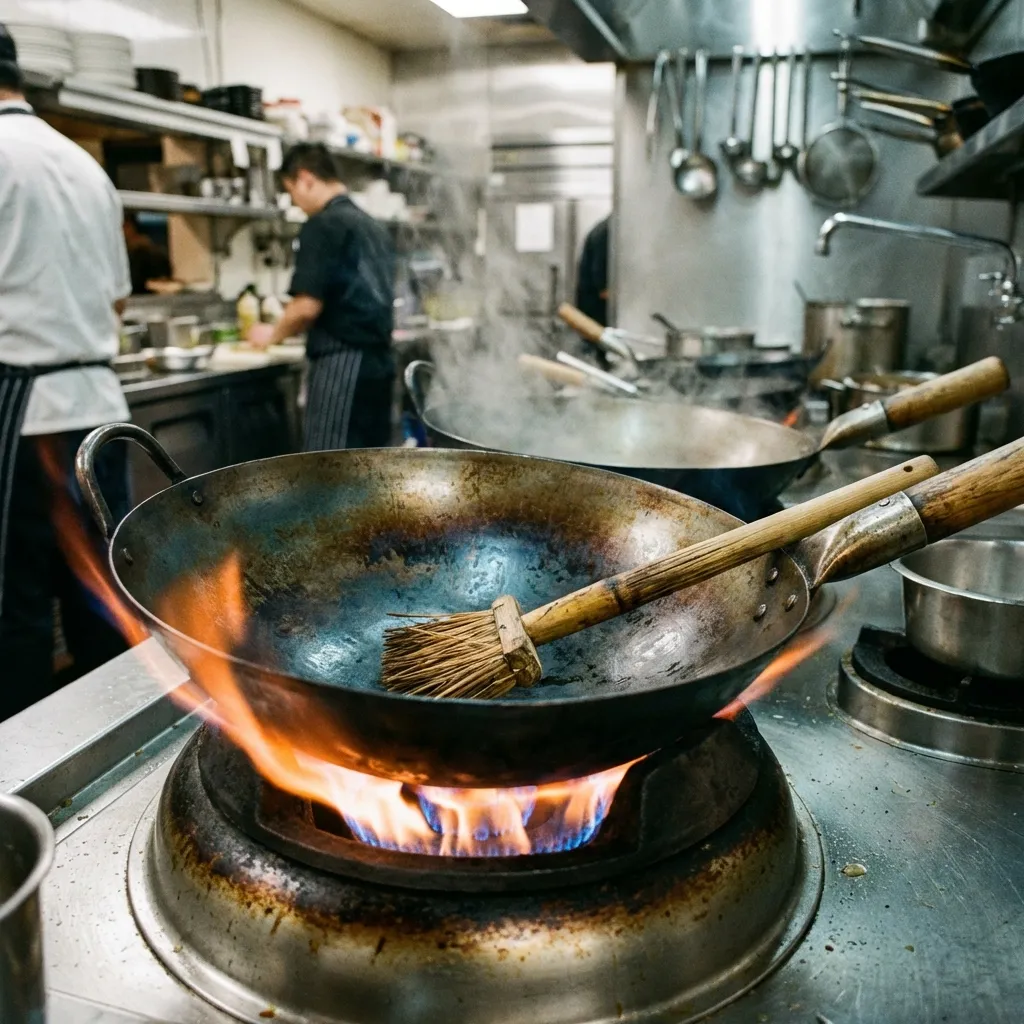
"A carbon steel wok is the heart of a Singaporean home kitchen. But without proper seasoning, it's just a rusty metal bowl waiting to happen. Here is how to transform raw steel into a non-stick, flavour-building legend that will serve your family for generations."
Wok Wisdom at a Glance
- 1 Carbon steel woks need seasoning before use—factory coating must be scrubbed off first
- 2 The 'blue steel' phase (heating until colour changes) creates the base for oil to bond
- 3 Use high smoke-point oil and aromatics (chives, ginger) to build the first patina layer
- 4 Never use soap after initial scrub—hot water and bamboo brush only
- 5 Always dry immediately and store with a thin oil coating to prevent rust
Why Every Home Kitchen Needs a Carbon Steel Wok
Walk into any proper Singaporean home kitchen and you'll find it: a carbon steel wok, its surface dark and gleaming with years of use. This isn't just cookware—it's a family heirloom in the making.
Forget your fancy non-stick pans with their delicate coatings. Teflon wilts under the intense heat required for authentic wok cooking. It starts breaking down at temperatures that a proper stir-fry demands. Carbon steel? It laughs at high heat. It begs for it.
"My mother's wok is 40 years old," shares home cook Mrs. Tan. "Black as night, smoother than any non-stick pan you can buy. She passed it to me when I got married. Best dowry ever."
💡 A well-seasoned wok develops what the Chinese call 'wok hei'—the breath of the wok. That smoky, slightly charred flavour that makes restaurant fried rice taste so good? That comes from a properly seasoned wok at screaming high heat. No amount of cooking skill can replicate it without the right tool.
Carbon steel is also incredibly durable. Drop it, bash it, use metal utensils on it—it doesn't care. It improves with age, building layer upon layer of polymerised oil that creates a natural non-stick surface. Your great-grandchildren could be cooking with your wok if you treat it right.
Choosing the Right Wok
Not all woks are created equal. Before you season, you need to start with the right vessel.
Material: Carbon Steel or Bust
Look for woks made from carbon steel, typically 1.5-2mm thick. Avoid stainless steel (poor heat distribution), cast iron (too heavy for tossing), or aluminium (won't hold up to high heat). The wok should feel light enough to toss with one hand—around 1-1.5kg is ideal.
Shape: Round vs. Flat Bottom
Traditional round-bottom woks work best on high-BTU gas burners or with a wok ring. For home stoves in Singapore, a flat-bottom wok makes more sense—it sits stable on your standard gas or induction hob. The flat section should be about 10-12cm wide.
Size Matters
For a family of 4-6, go for a 35-36cm (14-inch) wok. This gives you room to toss ingredients without them flying out. Smaller woks (30cm) work for couples or singles.
🎯 When shopping, look for woks with a single long handle—these are called Cantonese-style woks and are easier for home cooking. Avoid woks with two small handles (Northern-style), which are harder to manoeuvre on home stoves.
"I see people buy those fancy woks with all the curves and coating," says veteran kitchenware seller Mr. Lim at Sia Huat. "Waste money lah. Plain carbon steel, maybe $30-40. Last forever. Those expensive ones, coating peel off after one year."
Step 1: The Factory Coat Scrub Down
Your brand new wok arrives with a factory-applied coating—usually a layer of protective oil or lacquer to prevent rust during shipping. This must come off completely before you begin seasoning.
What You'll Need:
• Steel wool or scouring pad
• Dish soap (yes, this is the ONLY time you use soap)
• Hot water
• Dry towel
The Process:
Fill your sink with hot, soapy water and submerge the wok. Using the steel wool, scrub every inch—inside, outside, handle area. Apply serious elbow grease. The goal is to remove every trace of factory coating.
You'll know you're done when:
• The water runs completely clear
• The wok surface looks dull grey/silver, almost raw
• Running your finger over the surface feels 'grippy', not slick
💡 Don't skip the outside of the wok—it needs seasoning too, especially the lower section that gets direct flame contact.
Rinse thoroughly with hot water. Dry immediately with a towel, then place on a low flame for a minute to evaporate any remaining moisture. Rust is your enemy from this point forward—never let the wok sit wet.
"This part very satisfying one," admits home cook Jonathan. "Like giving birth to your wok. Before this, it's just metal. After scrubbing, you ready to give it a soul."
Step 2: The Heat Transformation (Blue Steel Phase)
This is the dramatic part. You're about to transform raw steel into something special through intense heat.
Open Your Windows First
Seriously. This process creates smoke. A lot of smoke. Turn on your exhaust fan, open windows, maybe temporarily disable your smoke detector. Don't be alarmed—the smoke is just the manufacturing residue burning off.
The Process:
Place your clean, dry wok on the stove. Turn the heat to maximum—the highest your burner goes. Stand by with a pair of tongs or a kitchen towel (for grabbing the handle).
Watch the wok closely. Over the next 5-10 minutes, you'll see the colour change:
• Grey/silver → Yellowish → Straw colour → Blue → Dark blue → Almost black in some spots
This is the 'blue steel' phase. The metal is oxidising at high temperature, creating a base layer that oil will bond to later.
Rotate the wok constantly, tilting it so every part of the surface—bottom, sides, rim—gets blasted by the flame. Use the tongs to hold the handle if it gets too hot.
🎯 The colour change starts from the hottest point and spreads outward. Focus on areas that remain stubbornly grey or shiny—tilt the wok to bring those sections directly over the flame.
"The first time I did this, I thought I broke my wok," laughs home chef Sarah. "It turned all these crazy colours. My husband came running thinking something was on fire. But that blue colour—that's when you know you're doing it right."
💡 If your home stove doesn't get hot enough (common with older stoves), do this step on an outdoor portable burner or even a camping stove. The hotter, the better.
Step 3: The First Oil Seasoning
Now we build the first layer of patina—the black, non-stick coating that defines a well-loved wok.
What You'll Need:
• High smoke-point oil (peanut, canola, or vegetable oil)
• A bunch of Chinese chives (garlic chives) OR green onion/spring onion whites and ginger slices
• Paper towels or kitchen towel
• Tongs or a wok spatula
The Process:
Let your wok cool slightly after the blue steel phase—you want it hot but not dangerously so. Add 2-3 tablespoons of oil and swirl it around to coat the entire inner surface.
Add your aromatics: a handful of chive stalks, or chopped spring onions with several slices of ginger. Using a wok spatula, press and rub these around the entire wok surface—bottom, sides, everywhere. The goal is to distribute oil and flavour into every pore of the metal.
Fry until the aromatics are completely blackened and charred, about 5-7 minutes on high heat. Don't worry about burning them—that's exactly what should happen.
"My grandmother always used chives for this," shares Mrs. Wong. "She say the allicin in the garlic helps the oil bond to the metal. I don't know the science, but her method works."
🎯 Save your expensive aromatics for cooking. The cheapest bunch of chives from the wet market is perfect for seasoning. They're just a vehicle for the oil.
Discard the charred aromatics. Using paper towels (careful, it's hot!), rub the oily residue all over the wok surface. Add another tablespoon of fresh oil and repeat the frying-and-rubbing process 2-3 more times.
💡 Your wok won't look perfectly black after this first session. It'll be patchy—darker in some spots, lighter in others. This is normal. The patina builds over months of cooking.
Step 4: The Oven Method (Alternative)
If the stovetop method feels too intense or your stove doesn't get hot enough, there's an alternative: the oven method. Some wok enthusiasts actually prefer this for a more even initial seasoning.
The Process:
Preheat your oven to its maximum temperature—usually 230-260°C (450-500°F).
After the scrub-down (Step 1), coat your wok with a very thin layer of high smoke-point oil. Use a paper towel to wipe off excess—you want the surface barely glistening, not wet. Too much oil creates a sticky residue instead of a smooth patina.
Place the wok upside-down on the middle oven rack. Put aluminium foil on the bottom rack to catch any drips.
Bake for 30-45 minutes. The oil will polymerise, bonding to the metal surface. Smoke may emerge—this is normal.
Turn off the oven and let the wok cool inside completely. Repeat this process 3-5 times for a solid base layer.
🎯 The oven method creates a more uniform base seasoning, but you still need to do some stovetop seasoning afterwards for the intense heat exposure that builds wok hei.
"I use oven method first, then stovetop method on top," reveals experienced home cook David. "Best of both worlds. Oven gives you even base coat. Stovetop gives you the character."
💡 After oven seasoning, your wok might look brown or bronze rather than black. Don't worry—the dark patina develops with actual cooking over time.
Your First Cooks: Building the Patina
Your wok is now seasoned, but it's still a teenager—awkward and not quite living up to its potential. The first few cooking sessions are crucial for building that legendary non-stick surface.
Stick to Fatty, Forgiving Foods:
For your first 5-10 cooking sessions, choose dishes that involve plenty of oil and won't stick easily:
• Stir-fried vegetables with generous oil
• Bacon or fatty pork belly
• Scrambled eggs (surprisingly good for seasoning)
• Deep-fried anything
Avoid lean proteins like chicken breast or acidic ingredients like tomatoes until your patina is more established.
"First month, I only cook sambal kangkong in my new wok," shares home cook Mei Ling. "Lots of oil, quick cooking. The wok love it. After one month, I can fry fish without sticking."
💡 If food sticks during your first cooks, don't panic. This is normal. Just add more oil, cook a bit longer, and scrape it off. Every cook adds to the seasoning.
After Each Cook:
While the wok is still warm (not screaming hot), rinse with hot water. Use a bamboo brush or the non-abrasive side of a sponge to gently remove food bits. No soap—ever again.
Place the wok back on the stove over low heat for 1-2 minutes until completely dry. Apply a tiny drop of oil (half a teaspoon) and rub it over the cooking surface with a paper towel. Store somewhere dry.
🎯 That thin oil layer is your rust insurance. Skip it and you'll wake up to an orange-spotted wok, especially in Singapore's humidity.
The Golden Rules of Wok Care
You've invested time into seasoning your wok. Now keep it happy with these commandments:
Rule 1: Never Use Soap (After Initial Scrub)
Soap strips the oil patina you've worked to build. Hot water and a bamboo brush are all you need for 99% of cleaning. If something really stubborn is stuck, use salt as an abrasive—add coarse salt to the wok, scrub with a paper towel, then rinse.
Rule 2: Always Dry Immediately
Never, ever leave your wok sitting wet. Rust develops within hours in Singapore's humidity. After washing, heat the wok on the stove until all moisture evaporates. You'll see the water steam off—wait until it stops.
Rule 3: Store With a Light Oil Coat
That thin oil layer prevents rust between uses. If you cook daily, you might skip this. If you cook weekly, always oil before storing.
Rule 4: High Heat Is Your Friend
Carbon steel woks are designed for intense heat. Cooking on low-medium heat doesn't build patina as effectively. When stir-frying, get the wok smoking hot before adding oil, then work fast.
"I tell my daughter: treat the wok like your husband," jokes Mrs. Tan. "Keep it dry, give it attention, don't be harsh with it. Take care, and it takes care of you."
💡 If you're going away for a while and storing the wok long-term, apply a thicker coat of oil and wrap it loosely in newspaper. Check monthly for rust.
🎯 Using your wok for deep-frying is actually great for the seasoning—the prolonged oil contact builds the patina beautifully. Win-win.
Troubleshooting: When Things Go Wrong
Even the best-intentioned wok owners encounter problems. Here's how to fix them:
Problem: Rust Spots
Don't despair. Rust is reversible. Scrub the rust off with steel wool until you're back to bare metal in those spots. Re-season just those areas with the stovetop oil method. For light surface rust, sometimes just cooking a fatty dish is enough to seal it back up.
Problem: Sticky Residue
This happens when too much oil was applied or the wok wasn't heated enough during seasoning. Burn it off by heating the wok empty until the residue carbonises, then scrub and re-season.
Problem: Food Sticking
Possible causes:
• Not enough oil during cooking
• Wok wasn't hot enough before adding food
• Patina not developed enough (give it more time)
• Acidic ingredients stripping the seasoning
"My wok was doing great, then I cook sweet and sour pork," recalls home cook Raymond. "Tomato and vinegar strip my patina clean. Had to re-season. Now I use stainless steel for acidic dishes."
💡 If your wok needs complete re-seasoning, don't stress. Start from the blue steel phase and rebuild. It happens to everyone at some point.
Problem: Flaking Black Bits
This means the seasoning is too thick or was applied unevenly. Scrub off the flaky areas and build up again gradually. Thinner layers bond better than thick coats.
🎯 Some professional chefs intentionally strip and re-season their woks every few years to start fresh. It's maintenance, not failure.
The Patina Journey: What to Expect Over Time
Seasoning a wok isn't a one-time event—it's an ongoing relationship. Here's what your wok will look like through its life stages:
Week 1-4: The Awkward Phase
Patchy colour, some sticking, requires extra oil. The patina is just beginning. Be patient.
Month 1-3: Building Character
The cooking surface should be noticeably darker. Sticking decreases. You might see distinct colour rings where different heat levels hit the surface.
Month 3-12: The Confident Phase
Deep black in the cooking area, possibly brown or bronze on upper walls. Minimal sticking. Eggs slide around like an ice rink.
Year 1+: The Legend
Mirror-smooth, jet black, effortlessly non-stick. Your wok has character—literally and figuratively. People will ask about it.
"My grandmother's wok was so black, so smooth, it look like liquid metal," recalls chef Dennis. "She cook on it 50 years. Never wash with soap, never let it rust. When she pass, my cousin and I fight over who get the wok. More valuable than any inheritance."
💡 Photograph your wok's progress. It sounds silly, but it's satisfying to look back at Week 1 versus Year 1. The transformation is real.
🎯 If your wok develops 'layers' of patina that look like tree rings, that's a sign of excellent seasoning. Each ring represents a cooking session. It's your wok's biography.
Beyond Stir-Frying: What Else to Cook
A well-seasoned wok isn't just for stir-fries. It's one of the most versatile tools in any home kitchen.
Deep-Frying
The wok's shape—wide at top, narrow at bottom—uses less oil for the same frying capacity as a straight-sided pot. Perfect for curry puffs, spring rolls, or prawn fritters. The high sides prevent splattering.
Steaming
Place a bamboo steamer rack inside, add water, and you've got a steamer. Dim sum, fish, vegetables—all work beautifully.
Smoking
Line the wok with foil, add wood chips or tea leaves and rice, place a rack on top, cover tightly—instant smoker. Try it with duck breast.
Braising
Don't need the whole Dutch oven for small batches. Braise pork belly or beef cheeks right in the wok.
Popping
Popcorn, seriously. The high sides and even heat make for perfect popping with no escapes.
"I tell my friends: you only need three things in kitchen—wok, rice cooker, and sharp knife," says home cook Auntie Linda. "Wok can do everything. Even boil pasta if you need."
💡 When using your wok for steaming or braising with liquid, dry it thoroughly and oil lightly afterwards. Prolonged moisture contact can affect the seasoning.
🎯 That 'extra' wok you seasoned as backup? Use it as your dedicated deep-frying wok. Keeps the flavours separate and builds incredible seasoning from all that oil.