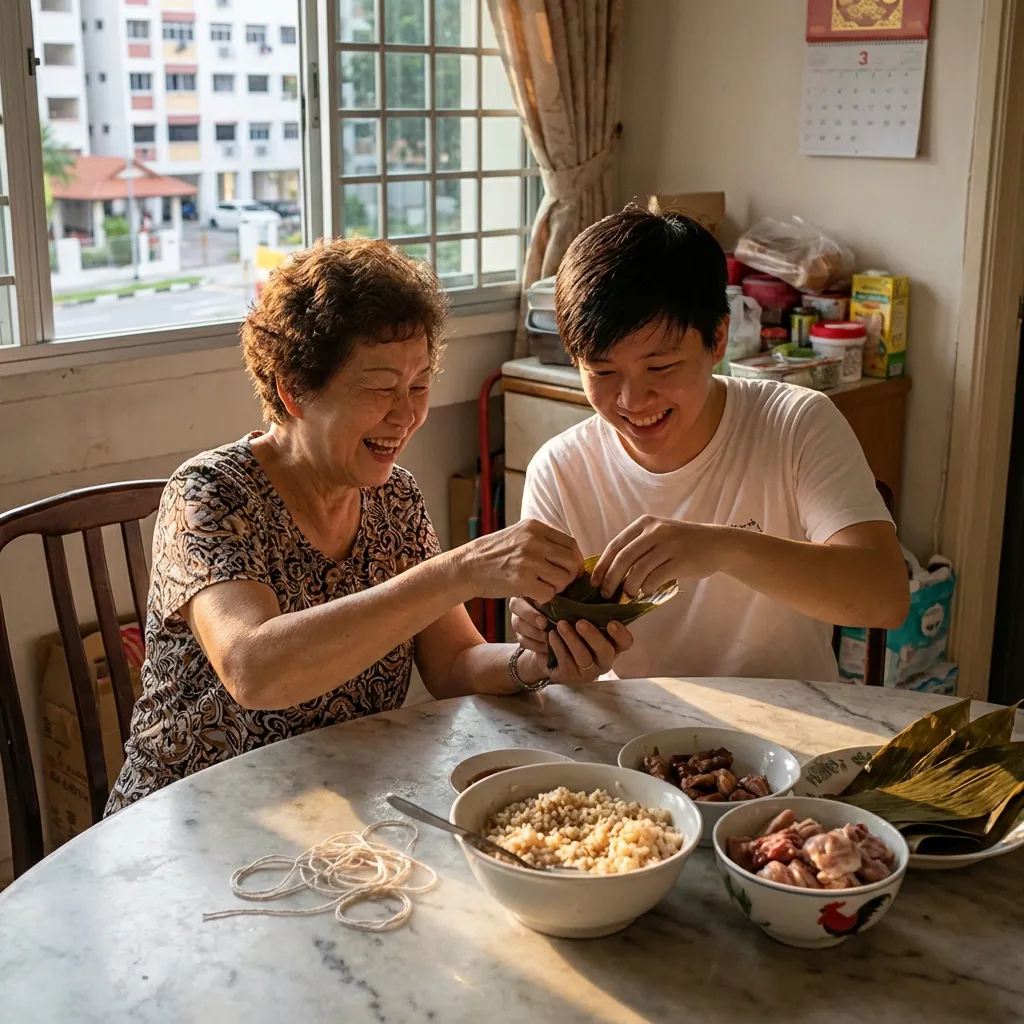
"We asked ten veteran home cooks—with a combined 400+ years of kitchen experience—for the one piece of advice they'd give to the next generation. Here's what they shared, unfiltered."
Wisdom from the Wok
- 1 Moisture is the enemy of searing—dry your mushrooms, dry your meat
- 2 Cold oil infuses flavour from aromatics; hot oil sears protein
- 3 Don't overcrowd the pan—cook in batches for better results
- 4 Let the wok breathe—stop stirring constantly to develop char and flavour
- 5 The secret ingredient is love—attention and care make home cooking special
The Wisdom of Experienced Hands
There's knowledge you can learn from cookbooks, and there's knowledge that only comes from cooking ten thousand meals over fifty years. The latter is what we sought when we sat down with some of Singapore's most accomplished home cooks—aunties and uncles whose families line up for their cooking, whose recipes are guarded like state secrets.
These aren't professional chefs with culinary school training. They're mothers, fathers, and grandparents who learned by watching, failing, and trying again. Their kitchens don't have sous vide machines or precision thermometers. They have dented woks, trusty cleavers, and decades of accumulated intuition.
"Book recipe tell you teaspoon of this, tablespoon of that," explains Auntie Lim, 74, shaking her head. "But your teaspoon is different from my teaspoon. Your ingredient is different quality. You must learn to feel the right amount, taste the right balance."
What follows are their distilled insights—advice so fundamental that it's almost invisible to experienced cooks, yet transformative for those still learning.
Secret #1: Don't Wash Your Mushrooms
"Mushrooms are like sponges. If you wash them, they absorb water and when you fry, they steam instead of frying. You lose all the flavour, all the texture. Just wipe them with a damp cloth—that's enough."
— Madam Lim, 72, Tampines
This seemingly minor tip reveals a deeper principle: many ingredients have ideal moisture levels that washing disrupts. Fresh mushrooms should sizzle and brown when they hit the pan, developing deep umami through the Maillard reaction. Waterlogged mushrooms simply expel moisture and turn grey and rubbery.
The same principle applies to meat you're planning to sear—pat it dry with paper towels first. Moisture creates steam; steam prevents browning; browning creates flavour.
If your mushrooms are genuinely dirty (not just dusty), use a pastry brush to remove debris rather than rinsing.
This applies to leafy greens too—wash and dry them thoroughly before stir-frying. A salad spinner is a worthwhile investment for any home cook who makes frequent stir-fries.
Secret #2: Scissors Are More Important Than Knives
"In a Chinese kitchen, good scissors are more important than a chef's knife. Use them to trim fat, cut noodles, debone chicken wings, chop scallions directly into the pot. Less washing, less cutting board. My scissors do half my prep work."
— Uncle Tan, 65, Bedok
Western cooking education emphasises knife skills. But Asian home cooks have long known that kitchen scissors (especially the heavy-duty Japanese or Korean varieties) handle many tasks more efficiently. They're safer for cutting slippery raw chicken, faster for snipping herbs, and create less mess overall.
Some specific uses that Uncle Tan demonstrates: cutting kimchi directly into a stew, trimming the edges off dried mushrooms after soaking, portioning noodles in a bowl, and jointing a whole chicken (the joints cut surprisingly easily with good scissors).
"Young people think they need all these expensive knives," he laughs. "I use three things: cleaver, scissors, small paring knife. Sixty years of cooking, never needed more."
Choose scissors with one micro-serrated blade for better grip on slippery ingredients.
Keep a dedicated pair in a small jar by the stove for quick snipping. Wash immediately after raw meat contact.
Secret #3: Taste As You Go, But Account for Reduction
"Remember that sauces get saltier as they cook down. If it tastes perfect at the start, it will be too salty at the end. Season conservatively first, then adjust at the final stage. The water evaporates, but the salt stays."
— Sarah, 45, Bukit Timah
This is one of the most common mistakes even experienced cooks make. A braised dish tastes perfectly seasoned when it's swimming in liquid, but after an hour of simmering, that liquid has reduced by half and the salt concentration has doubled.
Sarah's approach: undersalt by about 30% during initial cooking, then taste and adjust when the dish is nearly finished. For dishes that reduce significantly (curry, braised meats), she waits until the final 15 minutes to fine-tune.
The corollary is equally important: if a sauce is too salty, you can sometimes save it by adding unsalted liquid and continuing to cook. But this changes the texture and concentration of other flavours—a fix, but not an ideal one.
Keep a glass of water nearby and take a sip between tastes. It resets your palate and prevents 'seasoning creep' where repeated tasting dulls your sensitivity.
Sugar can balance salt. If a dish is slightly too salty, a pinch of sugar often saves it without making it taste sweet.
Secret #4: Cold Oil for Aromatics, Hot Oil for Searing
"If you want to infuse oil with garlic or dried shrimp, start cold and let it heat up slowly. If you throw them into hot oil, they burn before the flavour comes out. But for searing meat, you want the oil smoking hot so the meat doesn't stick."
— Auntie May, 58, Ang Mo Kio
This single piece of advice solves many beginner problems. The technique is called "cold-oil infusion" in culinary terms, and it works because delicate aromatics need gentle heat to release their volatile flavour compounds. High heat destroys these compounds faster than they can transfer to the oil.
Auntie May demonstrates with dried shrimp: she puts a tablespoon of oil in a cold wok, adds the shrimp, and turns the heat to medium. As the oil heats, the shrimp gradually turns golden and the kitchen fills with intense umami fragrance. By contrast, tossing dried shrimp into smoking oil produces burning and bitterness within seconds.
For searing meat, the opposite applies. You want the Maillard reaction to happen before moisture can leach out—which requires immediate, intense heat. Cold oil means the meat stews in its own juices.
You can tell oil is hot enough for searing when it shimmers and flows like water. A drop of water flicked in should sizzle violently.
For garlic specifically, the slicing method matters. Sliced garlic for cold-oil infusion gives a mellow, sweet flavour. Minced garlic in hot oil gives a sharper, more pungent note. Choose based on what the dish needs.
Secret #5: Rest Your Meat (Yes, Even Stir-Fry)
"Everyone knows to rest steaks and roasts. But even simple stir-fried beef slices benefit from resting. After you cook them, set them aside for even one minute before plating. The fibres relax and the juices redistribute. Small thing, big difference."
— David, 40, Marine Parade
David is a mechanical engineer who brings a scientific mindset to his cooking. His explanation: when meat cooks, the muscle fibres contract and squeeze moisture towards the centre. If you cut or serve immediately, that concentrated moisture spills out. A brief rest allows the fibres to relax and reabsorb liquid evenly.
For stir-fries, he recommends a simple technique: cook your protein first, remove it to a plate, cook your vegetables, then return the protein just before serving. The protein naturally rests while the vegetables cook, and gets reheated just enough when combined.
For larger pieces of meat, the principle scales up. A roast chicken should rest for 15-20 minutes. A steak, 5-7 minutes. The meat will stay warm longer than you expect.
Tent resting meat loosely with foil. Tight wrapping traps steam and softens the crust you worked to create.
Rest your meat on a wire rack rather than a plate. This prevents the bottom from getting soggy from pooled juices.
Secret #6: The Nose Knows Before the Eyes
"I cook by smell more than by sight. When the garlic smells fragrant, add the next ingredient. When you smell burning, you waited too long. When the dish smells complete, it usually is. Train your nose—it's faster than checking with your eyes."
— Mdm. Ong, 69, Toa Payoh
Mdm. Ong is legally blind in one eye and cooks almost entirely by smell and touch. Her food is legendary in her HDB block—neighbours place orders for her curry chicken during festive seasons.
"When I first lost my vision, I thought my cooking days were over," she shares. "But I discovered I was already cooking by smell. I just didn't know it. The eyes were just confirming what the nose already knew."
Her advice for developing this skill: close your eyes while cooking familiar dishes and pay attention to the smell progression. Garlic goes from raw and sharp to fragrant and sweet to acrid and burnt. Onions progress from pungent to sweet to caramelised. These smell transitions happen before the visual changes become obvious.
Your first sense of burning often comes from smell, not sight. If something smells off, take action immediately—don't wait to see smoke.
The smell of 'wok hei'—that smoky, charred aroma—is your cue that the stir-fry is developing properly. It should smell exciting, not acrid.
Secret #7: Overcrowding Is the Silent Killer
"The number one mistake I see: putting too much food in the pan. The pan temperature drops, water comes out, everything steams instead of fries. Better to cook in three batches with good results than one batch of soggy mess. Patience is faster than impatience."
— Uncle Raymond, 62, Clementi
Uncle Raymond spent 30 years as a hawker before retiring, and he watches home cooks with the pained expression of a professional watching amateurs. His biggest frustration? Home cooks who rush.
"At the hawker stall, I cook small portions over very high heat. Each plate takes 90 seconds. At home, people try to cook for four in one go with medium heat. Takes 10 minutes and tastes like nothing. If they just cooked four small batches, each would be delicious and the total time would be six minutes."
The science is simple: every ingredient you add drops the pan temperature. Professional kitchens compensate with powerful burners home stoves can't match. The only home cook solution is smaller batches and patience.
If you hear your pan go from sizzling to silent when you add food, you've overcrowded it. Remove some and cook in batches.
Keep your first batches warm in a low oven (100°C) while you finish the rest. They'll stay hot without overcooking.
Secret #8: The Wok Needs to Breathe
"Don't stir constantly. The food needs to sit on the hot surface to develop colour and flavour. Stir, then let it sit for 10-15 seconds. Stir again. If you keep moving the food, it never gets hot enough to sear. Let the wok do its job."
— Auntie Rosie, 55, Serangoon
Auntie Rosie trained as a dim sum chef in Hong Kong before settling in Singapore. Her technique is noticeably different from most home cooks—she tosses her wok with dramatic flourishes, but between tosses, she lets the food sit untouched against the hot metal.
"I watch people stir-fry and they're stirring constantly, like they're afraid," she observes. "But constant stirring means nothing ever touches the wok long enough to brown. You get grey food with no character."
Her pattern: add ingredients, toss to distribute, then hands off for 15-20 seconds while the bottom layer browns. Toss to rotate, another pause. Repeat until done. The result is vegetables that are charred on edges but bright and crisp overall—the hallmark of proper wok cooking.
Listen for the sizzle. Active sizzling means the heat is right. Silent cooking means too much moisture or not enough heat.
Practice tossing with dried beans or rice in a cold wok. It takes 50-100 repetitions to develop the wrist motion, but once you have it, your stir-fries transform.
Secret #9: Save Everything
"Shrimp shells make stock. Chicken bones make stock. Vegetable scraps make stock. Parmesan rinds go in soup. Old bread becomes breadcrumbs. Nothing is waste—everything is ingredient for tomorrow."
— Mdm. Chen, 76, Geylang
Mdm. Chen grew up poor and carries that frugality into her cooking today. Her freezer contains carefully labelled bags of what most people throw away: prawn heads and shells, chicken backbones, ginger ends, wilting herbs, mushroom stems.
"Young people spend $5 on stock in a box. I make better stock for free from things they throw away," she says with visible pride.
Her specific tips:
- Shrimp shells + heads: Toast in a dry pan until pink and fragrant, then simmer in water for 20 minutes for bisque-worthy stock
- Chicken bones: Roast until golden, then simmer for hours for rich bone broth
- Vegetable scraps: Freeze until you have enough, then simmer for vegetable stock
- Parmesan rinds: Add to soups and risottos for umami depth
Keep a 'stock bag' in your freezer. Add clean scraps as you cook. When it's full, you have free homemade stock.
Label your freezer bags with contents and date. Even frozen items degrade over time—use within 3 months for best flavour.
Secret #10: Cook for Someone You Love
"The secret ingredient that no recipe includes: love. When you cook for someone you love, you pay attention. You taste carefully. You don't cut corners. That attention is what makes home cooking special. If you cook like it's a chore, the food tastes like a chore."
— Auntie Mary, 80, Queenstown
Auntie Mary is the oldest cook we interviewed, and perhaps the wisest. She's been cooking daily for 60 years—first for her late husband, then for her children, now for her grandchildren. Her hands shake slightly, but her curry still draws the whole family home every Sunday.
"People ask me, 'What's your secret recipe?' But there's no secret ingredient. I use the same curry powder everyone uses. The difference is that I cook for people I love, so I cook carefully. I don't rush. I taste and adjust. I make sure it's right before I serve."
Her observation cuts to the heart of home cooking: the best dishes come from cooks who care. Professional chefs have skills and equipment, but home cooks have something restaurants can never replicate—the irreplaceable ingredient of cooking with love for specific people.
When you're feeling unmotivated to cook, remember who you're cooking for. It changes the experience from chore to gift.
Involve the people you're cooking for. Let kids stir the pot, let partners chop vegetables. Cooking together multiplies the love.
Carrying the Tradition Forward
These secrets aren't really secrets at all. They're the accumulated wisdom of generations, passed down through watching and practice, through trial and error, through thousands of family meals.
What strikes us most from these conversations is how universal the advice is. Whether the cook is Teochew or Peranakan, Malay or Indian, the fundamentals remain constant: respect your ingredients, master the basics, cook with attention, and feed the people you love.
"In my generation, every woman could cook," reflects Auntie Mary. "Not because we were talented, but because we had no choice. You learned from your mother, you practiced every day, and eventually you got good. Young people today have too many options—they can order food, eat out, buy frozen. They never have to learn."
"But," she adds with a smile, "the ones who do learn, they discover something precious. The satisfaction of feeding your family with your own hands. The joy of a recipe that becomes yours. The connection to all the mothers and grandmothers who came before. That's worth more than convenience."
These tips are our small contribution to keeping that tradition alive. May they serve you as well as they've served us.
Ready to practice?
Start with the essential dishes every home cook should master.
10 Essential Dishes