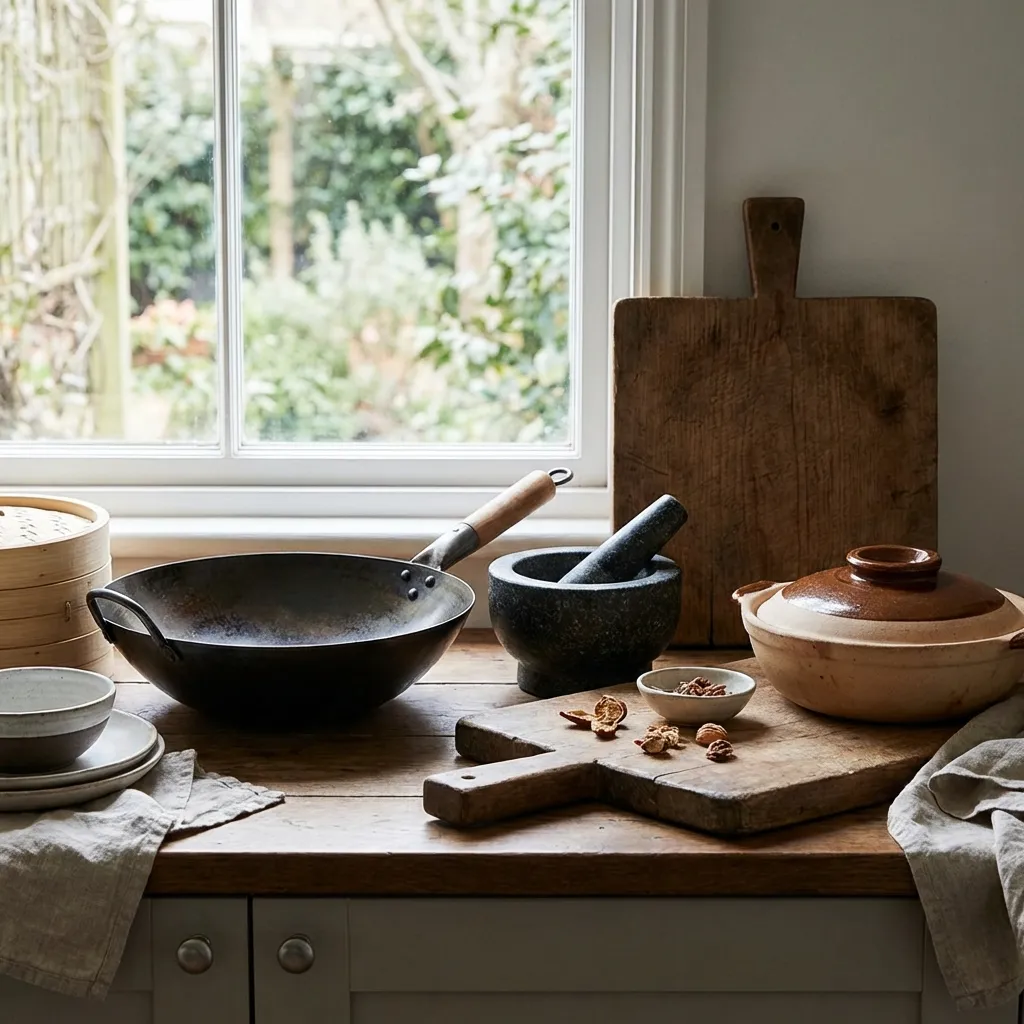
Home Kitchen Essentials: Tools Singapore Home Chefs Swear By
"From heavy-duty woks to the perfect mortar and pestle, here are the must-have tools for any Singaporean home kitchen. Build your arsenal right, and you'll be cooking like your grandmother in no time."
Kitchen Essentials at a Glance
- 1 Wok + Cleaver + Chopping Board = the holy trinity of Singaporean cooking
- 2 A granite mortar & pestle is irreplaceable for authentic sambal and rempah
- 3 Invest in quality basics over cheap gadgets—they last decades
- 4 Bamboo steamers and claypots unlock dishes that modern cookware can't replicate
- 5 Buy as you need, not all at once—let your cooking guide your purchases
Essential Kitchen Tools
Nice to Have Extras
Building Your Kitchen From Scratch
Every great Singaporean dish starts with the right tools. Walk into any serious home cook's kitchen and you'll find a curated collection of equipment—some handed down through generations, others picked up from Sia Huat or the neighbourhood provision shop.
But here's the truth: you don't need a kitchen full of gadgets. Professional aunties have been cooking miracles with just a wok, a cleaver, and a well-worn chopping board for decades. The key is to invest in quality essentials that will last, rather than accumulating cheap tools that frustrate.
"When I got married, my mother give me three things: her old wok, her stone mortar, and her recipe book," recalls Mrs. Lee, 62. "That's all you need, she say. Forty years later, I still using the same mortar. The wok I replace once—but only because I left it outside and it rust."
💡 Don't buy everything at once. Start with the absolute essentials—wok, cleaver, board—and add tools as you need them for specific recipes.
This guide walks you through the core equipment that defines a Singaporean home kitchen, with advice on what to look for, where to buy, and how to care for each piece.
The Carbon Steel Wok
If you own only one piece of cookware, make it a carbon steel wok. This isn't hyperbole—the wok is genuinely the most versatile tool in any kitchen. It stir-fries, deep-fries, steams, braises, smokes, boils, and even bakes.
Carbon steel heats rapidly and evenly, responding instantly to temperature changes. It's lightweight enough to toss with one hand but heavy enough to retain heat for proper searing. And unlike non-stick pans, it gets better with age—developing a natural non-stick patina called 'seasoning' that imparts that elusive smoky flavour known as 'wok hei.'
What to Look For:
• Material: Carbon steel, 1.5-2mm thick. Avoid stainless steel, aluminium, or pre-coated.
• Size: 35-36cm (14 inches) for families; 30cm for singles or couples.
• Shape: Flat-bottom for home stoves; round-bottom only if you have a high-BTU gas burner with wok ring.
• Handle: Single long handle (Cantonese-style) for easy tossing.
"I see people buy $200 wok from department store," laughs veteran home cook Mr. Tan. "My $35 wok from Sia Huat cook the same lah—maybe even better because I'm not scared to use it hard."
🎯 A new wok needs seasoning before use. Scrub off the factory coating, heat until the metal turns blue, then rub with oil and aromatics. See our full wok seasoning guide for the complete process.
💡 Store your wok with a light oil coating to prevent rust, especially in Singapore's humidity. If rust appears, scrub it off and re-season that area.
The Granite Mortar and Pestle (Batu Lesung)
This is where flavour begins. While food processors are convenient, they simply cannot replicate what a heavy granite mortar and pestle does to aromatics. The crushing action—as opposed to chopping—breaks cell walls and releases essential oils that a blade never touches.
Every great sambal, every proper rempah, every aromatic paste that forms the base of Peranakan and Malay cooking starts here. The rhythmic pounding is meditative, connecting you to generations of cooks who came before.
Why Stone Beats Machine:
• Crushing releases oils; chopping just cuts
• Temperature stays cool (blenders heat up)
• Texture control—smooth, coarse, or anywhere between
• Durable: a good mortar lasts literally forever
"My batu lesung belonged to my grandmother, then my mother, now me," shares home cook Auntie Siti. "That's 80 years of sambal. The stone smooth now from all the pounding. My daughter will inherit it next."
What to Look For:
• Material: Granite is best—heavy, durable, and doesn't absorb flavours. Avoid marble (too soft) or ceramic (can crack).
• Size: At least 18-20cm diameter for practical grinding. The deeper the bowl, the less splashing.
• Weight: Heavier is better. The mortar should feel immovable when you pound.
💡 Season a new mortar by grinding raw rice until the powder runs white (not grey). This removes stone dust and polishes the surface.
🎯 For sambal belacan, start with the dry ingredients (chillies, belacan) before adding wet ingredients (lime). Pound in one direction with a pressing, circular motion.
The Chinese Cleaver
Forget your fancy knife set with twelve different blades. A single Chinese cleaver—properly used—handles 95% of kitchen cutting tasks. It slices, dices, minces, crushes garlic, transfers ingredients, and its broad blade even serves as a makeshift bench scraper.
There are two main types: the thin-bladed vegetable cleaver (cai dao) for precision work, and the heavier bone cleaver for breaking down chickens and ribs. Most home cooks can get away with just the vegetable cleaver.
What to Look For:
• Blade: Thin (1.5-2mm) for vegetable cleaver; thicker (4-5mm) for bone cleaver
• Steel: Carbon steel holds a sharper edge but requires maintenance; stainless is easier to care for
• Weight: Should feel balanced—not too heavy to control, not so light it bounces
• Height: Tall blade (around 10cm) provides knuckle clearance and ingredient transfer surface
"First time my ang moh friend come to my kitchen, he scared of my cleaver," laughs Mr. Wong. "He think I going to chop bone with same knife I slice tomato. I show him the different style. Now he buy one too."
💡 Use the flat side of the cleaver to smash garlic and ginger—the cell walls break and the peel slips right off.
🎯 A cleaver's height is actually a safety feature. When slicing, curl your fingers and rest your knuckles against the flat of the blade—it guides the cut and keeps fingers safe.
The Heavy Chopping Board
Your cleaver needs a worthy partner. A flimsy cutting board that slides around or chips under impact is dangerous and frustrating. Singapore's home cooks have relied on thick, heavy wooden boards for generations.
Why Wood Beats Plastic:
• Self-healing: Wood fibres close up after cutting; plastic stays scarred
• Kinder to knives: Doesn't dull edges as quickly as glass or hard plastic
• Stability: Weight keeps it in place during vigorous chopping
• Natural antimicrobial properties (especially for certain woods)
What to Look For:
• Material: End-grain hardwood is the gold standard—acacia, teak, or rubberwood. Bamboo works but is harder on knives.
• Thickness: At least 4-5cm for stability and longevity
• Size: Big enough to work comfortably—at least 40cm x 30cm
• Feet or non-slip base: Prevents sliding
"Glass cutting board? Cannot lah," insists Auntie Mary. "Knife become blunt instantly. And the noise! Give me headache. Wood is best—I use same board 20 years, just oil it sometimes."
💡 Keep a damp towel under your board to prevent slipping if it doesn't have rubber feet.
🎯 Oil your wooden board monthly with food-safe mineral oil to prevent drying and cracking. Never soak in water or put in dishwasher—it will warp and split.
Bamboo Steamers
Steaming is one of the healthiest and most flavourful cooking methods—and bamboo steamers do it better than metal ones. The natural material absorbs excess moisture, preventing condensation from dripping back onto food and making it soggy.
Beyond functionality, there's something deeply satisfying about lifting a bamboo lid to reveal perfectly steamed dumplings or glistening fish. It connects you to centuries of Asian culinary tradition.
What They're Good For:
• Dim sum and dumplings
• Whole fish with ginger and soy
• Vegetables (especially leafy greens)
• Reheating bao and mantou without drying out
• Steaming rice cakes and kueh
What to Look For:
• Size: Match your wok—the steamer should sit snugly inside or on top
• Construction: Tightly woven bamboo; no gaps where steam escapes
• Depth: Deep enough for a whole fish or stackable for multi-level cooking
• Lid fit: Should sit securely to retain steam
"I stack three tiers sometimes," shares home cook David. "Bottom got vegetables, middle got fish, top got bao. One burner, three dishes. Very efficient!"
💡 Line your bamboo steamer with parchment paper, cabbage leaves, or banana leaves to prevent sticking and make cleanup easier.
🎯 Soak the steamer lid in water for a few minutes before use. This prevents the bamboo from absorbing too much steam and drying out over time.
The Claypot
Some dishes simply cannot be replicated without a claypot. The earthenware vessel heats slowly and evenly, then retains heat long after leaving the stove—keeping food warm throughout the meal. This gentle, enveloping heat is essential for dishes like claypot chicken rice, bak kut teh, and herbal soups.
Claypot cooking is alchemy: the porous material allows tiny amounts of moisture to escape, concentrating flavours while creating a slightly caramelised crust at the bottom.
Essential Claypot Dishes:
• Claypot Chicken Rice
• Bak Kut Teh
• Herbal Soups
• Braised Tofu
• Sesame Oil Chicken
What to Look For:
• Material: Unglazed earthenware for authentic cooking (glazed is easier to clean but less traditional)
• Size: 1.5-2 litres for a family of 4; smaller for individual portions
• Lid: Tight-fitting to trap steam and heat
• Handles: Large enough to grip with oven mitts
"First time use claypot, you must soak in water overnight," advises experienced cook Mrs. Tan. "Otherwise it crack when you heat. I learn this hard way—my first pot explode on the stove!"
💡 Always start claypots on low heat and gradually increase. Sudden temperature changes (like placing a hot pot on a wet surface) can crack it.
🎯 That slightly burnt rice at the bottom of claypot chicken rice? That's not a mistake—it's the best part. The Cantonese call it 'guo ba' (锅巴), and getting it right is a sign of a skilled cook.
Rice Cooker
Yes, you can cook rice in a pot on the stove. But a good rice cooker does it perfectly every time, without babysitting. In Singapore, where rice accompanies nearly every meal, this consistency matters.
Modern rice cookers go far beyond basic rice. They handle porridge (congee), brown rice, multi-grain rice, and some even have cake and slow-cook settings. The good ones sense moisture levels and adjust cooking automatically.
What to Look For:
• Capacity: 1.0-1.5L for couples; 1.8-2.0L for families
• Inner pot: Non-stick coating (easier cleanup) or stainless steel (more durable)
• Functions: At minimum, white rice and porridge settings; fuzzy logic models adjust cooking for different rice types
• Keep warm: Essential for meal prep; good cookers keep rice fresh for hours
"My mother use pot on stove for 60 years, never once burn the rice," says home cook Raymond. "Me? First time I try, burnt rice stuck to bottom, smoke everywhere. Rice cooker save my marriage."
💡 Let rice rest for 10-15 minutes after cooking before opening the lid. This allows moisture to redistribute evenly.
🎯 For extra flavour, cook your rice with a pandan leaf knotted inside. Remove before serving—the fragrance is wonderful.
Mesh Strainers and Spider Skimmers
Deep-frying and blanching are fundamental techniques in Singaporean cooking—and both require the right tools for safely moving food in and out of hot oil or water.
A spider skimmer (the wide, flat mesh strainer with a long handle) is indispensable. It drains quickly, won't trap excess oil, and keeps your hands far from splashing fat.
What You Need:
• Spider skimmer: Wide mesh, long bamboo or metal handle. Look for fine mesh that won't let small items slip through.
• Fine-mesh strainer: For straining stocks, sauces, and washing rice. Stainless steel with a hook that rests on pot edges.
• Small strainer: For skimming debris from oil or stock.
"When I fry curry puff, the spider is my best friend," shares hawker-trained home cook Auntie Linda. "In, out, drain, done. No soggy puff, no burn finger."
💡 After deep-frying, use a fine strainer to remove bits of batter floating in the oil. This keeps the oil clean for reuse and prevents burnt flavours.
🎯 A spider skimmer doubles as a blanching tool—lower vegetables into boiling water, count to thirty, lift out into ice water. Perfect for bright green kangkong or kai lan.
Where to Shop in Singapore
Building your kitchen is easier when you know where to look. Here are the tried-and-true sources for quality kitchen equipment:
Sia Huat (Temple Street)
The legendary kitchenware shop that supplies restaurants and home cooks alike. Industrial prices, massive selection. This is where serious cooks go for woks, cleavers, and commercial-grade equipment.
Phoon Huat
Originally a baking supplier, now stocking general kitchen equipment. Good for specialty items, baking tools, and bulk ingredients.
IKEA / ToTT
For modern kitchen tools, storage, and affordable basics. Not traditional, but practical.
Wet Markets and Neighbourhood Shops
For claypots, bamboo steamers, and mortar-and-pestles. Often better prices than retail shops, and you can inspect quality in person.
"Sia Huat can spend whole day there," warns Mr. Koh. "So much stuff! Better know what you want before you go, otherwise you buy everything."
💡 Don't overlook second-hand markets and online platforms like Carousell. Well-made vintage tools—especially cast iron and stone—are often better than modern equivalents.
🎯 Visit Sia Huat on a weekday morning for the least crowded experience. Weekends are packed with enthusiastic home cooks.
Ready to test your tools?
Put your kitchen arsenal to work with our collection of home-style recipes.
Explore Recipes