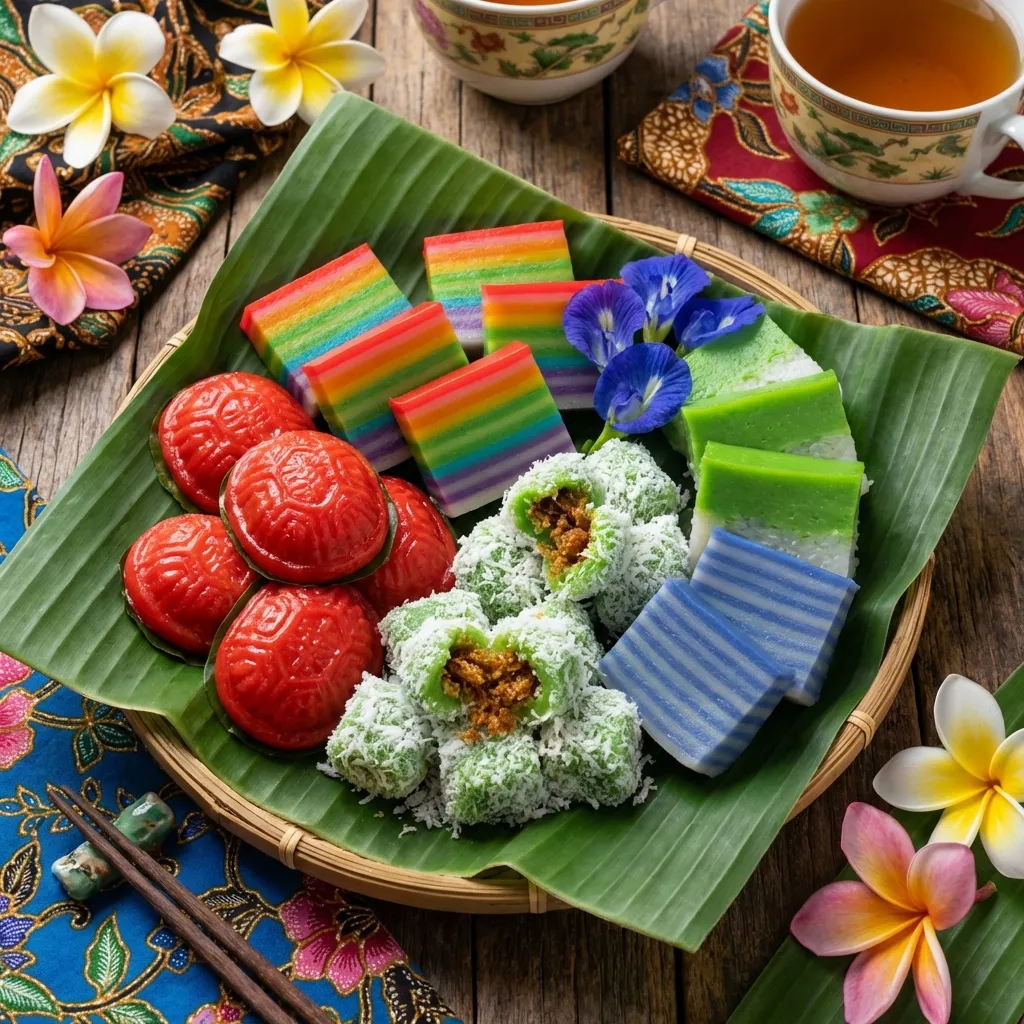
"Sticky, sweet, savoury, and always colourful. Nyonya, Malay, and Teochew kueh are the jewels of Singapore's food heritage—bite-sized treasures that connect us to generations past. How many can you name?"
Kueh Essentials
- 1 Kueh blends Malay, Nyonya, Teochew, and Hokkien traditions—each culture adds unique varieties
- 2 Common bases: glutinous rice flour, coconut milk, pandan, and gula melaka (palm sugar)
- 3 Always eat kueh fresh—most varieties don't survive more than a day
- 4 Different kueh suit different occasions: red for celebrations, white for funerals
- 5 Seek out wet markets and small family operations for the most authentic versions
What is Kueh?
Kueh (also spelled kuih, kue, or kwee) refers to bite-sized cakes and snacks common across Southeast Asia. In Singapore, kueh traditions blend Malay, Nyonya (Peranakan), Teochew, and Hokkien influences—a delicious reflection of our multicultural heritage.
Most kueh share common foundations: glutinous rice flour, coconut milk, pandan, and palm sugar. But within these constraints, infinite variations exist. Some are steamed, others baked, grilled, or fried. Some are sweet; others savory. All are meant to be eaten fresh—kueh rarely survives more than a day.
"My grandmother made kueh every week," recalls Nyonya heritage keeper Mdm. Tan. "Each occasion had its kueh. Birthdays: ang ku kueh. Weddings: kueh lapis. Funerals: white kueh bangkit. We speak our feelings through kueh."
💡 The best kueh is made fresh daily and eaten the same day. Most traditional kueh makers start before dawn. By afternoon, the day's batch is sold out.
This guide covers the essential kueh every Singaporean should know—from the iconic to the obscure, sweet to savoury. By the end, you'll be a kueh connoisseur.
Ang Ku Kueh (Red Tortoise Cake)
The quintessential Chinese-Singaporean kueh. Shaped like a tortoise shell and dyed red, ang ku kueh symbolises longevity and prosperity. No Chinese birthday or celebration is complete without these chewy red treats.
The skin is made from glutinous rice flour mixed with mashed sweet potato (sometimes pumpkin), giving it a soft, slightly sticky texture. Traditional fillings include sweet mung bean paste or ground peanut. Modern versions experiment with lotus paste, yam, and even durian.
"Red colour very important," insists fourth-generation ang ku kueh maker Mr. Ng. "Some people use food colouring, but traditional way is use ang zao—red yeast rice. Natural colour, deeper meaning."
The tortoise pattern isn't just decorative—in Chinese culture, tortoises represent longevity and wisdom. Giving ang ku kueh is giving a wish for long life.
💡 Fresh ang ku kueh should be slightly warm, with skin that yields gently when pressed but springs back. Cold, hardened ones have been sitting too long.
🎯 The peanut filling version (花生, hua sheng) is sweeter and grittier than the mung bean version. Peanut is more indulgent; mung bean is more refined. Know your preference before ordering.
Kueh Lapis Sagu (Nine Layer Cake)
This wobbly, multicoloured marvel is the kueh that children (and adults pretending to be mature) can't resist peeling layer by layer. Made from tapioca starch, rice flour, sugar, and coconut milk, each layer is steamed individually before the next is poured on top.
Traditional kueh lapis alternates between white (coconut) and coloured (pandan green, pandan red, or blue pea) layers. The exact number of layers varies—nine is common and auspicious in Chinese numerology. Some elaborate versions have 15 or more.
"Making kueh lapis test your patience," explains veteran kueh maker Auntie Mei. "Each layer must set before next layer. Rush, and layers blend together—no good. My grandmother's kueh lapis took whole morning. Thirty layers."
The texture should be bouncy and slightly chewy, with distinct layers that separate cleanly when peeled. A good kueh lapis jiggles when shaken.
💡 The layer-peeling ritual is half the fun. It's perfectly acceptable—expected, even—to eat kueh lapis one layer at a time, especially in front of children.
🎯 Look for kueh lapis with slightly caramelised edges. Some bakers brush the top layer with butter and torch it briefly for a bruléed finish. This elevated version is harder to find but worth seeking.
Ondeh Ondeh
These bright green balls are the most explosive kueh in Singapore's repertoire. The outside is pandan-infused glutinous rice dough, rolled in freshly grated coconut. The inside is a pocket of liquid gula melaka (palm sugar) that bursts in your mouth when you bite.
Eating ondeh ondeh is an act of faith. Bite too gently, and nothing happens. Bite correctly, and hot palm sugar floods your mouth with caramel sweetness. Bite incorrectly—say, while talking or laughing—and you're wearing that sugar syrup.
"First time I eat ondeh ondeh, I squirt my father," laughs teacher Ms. Ng. "Sugar spray everywhere. He laugh until cry. Now I always eat with mouth closed, lean forward."
The quality of ondeh ondeh depends on two things: the freshness of the grated coconut and the liquidity of the gula melaka. Pre-grated coconut turns dry and stale quickly. Solid sugar that hasn't melted properly is a sign of poor technique.
💡 The best ondeh ondeh is served warm, within hours of being made. The gula melaka should be completely liquid when you bite in.
🎯 Ask if the shop uses 'kelapa parut sekejap'—freshly grated coconut. The difference between fresh and pre-grated is night and day.
Kueh Salat (Seri Muka)
A two-layer masterpiece that showcases the Nyonya talent for contrast. The bottom layer is blue-tinged glutinous rice (coloured with bunga telang, butterfly pea flower). The top is a rich, emerald-green custard made from pandan, coconut milk, and eggs.
The textural and flavour contrast is deliberate: slightly salty, chewy rice against sweet, silky custard. Neither layer dominates; they're meant to be eaten together in each bite.
"Kueh salat is the queen of Nyonya kueh," declares Peranakan culture expert Dr. Lee. "It require skill, patience, and understanding of balance. Anyone can make tasty sweet thing. Making something taste both salty AND sweet, both chewy AND smooth—that is art."
The blue pea flower colour is entirely natural—no artificial dyes needed. The flower is soaked in water, which turns bright blue, then used to cook the glutinous rice.
💡 Cut kueh salat with a wet knife to prevent sticking. The layers should hold together without separating when lifted.
🎯 The custard layer should have a slight skin on top but remain creamy inside. Overbaked custard becomes rubbery; underbaked custard slides off the rice. The perfect balance is rare—treasure it when you find it.
Soon Kueh
A savoury Teochew masterpiece that proves kueh aren't always sweet. Soon kueh looks like a large crystal dumpling—translucent skin wrapped around a filling of turnip (actually jicama), bamboo shoots, and dried shrimp.
The skin is made from a blend of rice flour and tapioca starch, steamed until translucent but still chewy. The filling is stir-fried with shallots and seasoned simply, letting the vegetable flavours shine.
"My mother's soon kueh have more skin than filling," recalls food writer Raymond. "She say, 'Filling is cheap. Skin is skill.' She right. Good soon kueh skin—thin, smooth, not sticky, not torn—very hard to make."
Soon kueh is always served with a trio of condiments: sweet black sauce (tim cheong), chilli sauce, and sometimes soy sauce. The combination of chewy wrapper, crunchy filling, and sweet-spicy sauce is addictive.
💡 Eat soon kueh hot. The skin becomes tough and unpleasantly chewy when cold.
🎯 At traditional stalls, you can often ask for the sweet sauce to be drizzled over the kueh rather than served on the side. This way, every bite is perfectly sauced.
Kueh Dadar (Pandan Crepe)
Think of kueh dadar as Southeast Asia's answer to the crêpe—a thin, green pandan-flavoured pancake rolled around sweet grated coconut cooked in palm sugar.
The wrapper is made from rice flour, pandan juice, and eggs, cooked on a flat pan until just set. The filling—freshly grated coconut simmered with gula melaka until sticky and caramelised—is rolled inside.
"Kueh dadar is the kueh I make with my children," shares home cook Mrs. Fatimah. "Easy enough for small hands to help, but still taste like real Malay kueh. The rolling part—they love that."
The colour should be a natural green from real pandan, not the artificial neon green of shortcuts. The filling should be moist but not wet, sweet but not cloying.
💡 Fresh kueh dadar has a subtle pandan fragrance. If you can smell it from a distance, that's a good sign.
🎯 Some stalls add a thin layer of butter inside the wrap before adding the coconut filling. This adds richness and helps prevent sogginess. Ask if they do this—it's a small detail that makes a big difference.
Kueh Bangkit
These delicate, melt-in-your-mouth coconut cookies are a labour of love. Made from tapioca flour and coconut milk, they shatter at the slightest pressure, dissolving into a cloud of coconut flavour.
Traditional kueh bangkit are shaped using wooden moulds—intricate floral or geometric patterns that take generations to collect. The cookies are baked at low temperature until barely coloured, yielding a pure white appearance.
"Making kueh bangkit is meditation," explains heritage baker Mdm. Lim, whose family has made them for five generations. "The dough must rest overnight. The coconut milk must be just right—too thin, cookies crack; too thick, cookies don't rise. Everything must be precise."
The texture is everything: perfectly made kueh bangkit should crumble the moment they touch your tongue, leaving only coconut flavour behind. Too dense, and they're just ordinary cookies.
💡 Store kueh bangkit in an airtight container with a piece of bread to absorb moisture. Humidity is the enemy—it turns crisp cookies soft and sad.
🎯 The best kueh bangkit are handmade in small batches, often only during festive seasons. Factory-made versions lack the same delicacy. Seek out home bakers and family operations.
Kueh Tutu
A hawker centre favourite, kueh tutu is steamed on the spot in small metal cylinders, emerging as a soft white cake with a hidden centre of grated coconut or crushed peanut.
The outer layer is made from rice flour—so fine it's almost powdery—steamed just until set. The filling is pre-prepared: coconut mixed with palm sugar, or peanuts with sugar. The kueh is served hot, typically on a square of pandan leaf.
"The steam must be very strong," explains kueh tutu hawker Mr. Soh, who's been making them for 30 years. "Weak steam, the flour not cook properly—become hard. Strong steam, maybe 30 seconds, perfect. Soft like cloud."
The name 'tutu' is onomatopoeia—it mimics the sound of the steam escaping from the old-fashioned steamers.
💡 Always eat kueh tutu immediately. Within minutes, the delicate texture becomes dense. There's no 'saving some for later' with this kueh.
🎯 Coconut filling is sweeter; peanut filling is nuttier and slightly salty. Many regulars order 'half-half'—one of each—for variety.
Putu Piring
Not to be confused with kueh tutu, putu piring is the Malay cousin—larger, flatter, and with a more pronounced gula melaka centre. Steamed in round moulds, these disc-shaped rice cakes are served on banana leaves with fresh grated coconut.
The rice flour used for putu piring is coarser than kueh tutu, giving it a grainier texture. The centre holds a generous pool of melted palm sugar that oozes when you bite in—similar to ondeh ondeh's surprise but in a different form.
"Putu piring is kampung kueh," explains home cook Auntie Siti. "My grandmother make this in village—simple ingredients, simple tools. No fancy mould needed, just banana leaf and steam."
💡 The banana leaf isn't just packaging—it adds a subtle fragrance to the hot kueh. Don't discard it immediately; let the kueh rest on the leaf for maximum effect.
🎯 Look for stalls where you can see the steaming in progress. Freshness matters more for putu piring than almost any other kueh—the texture changes dramatically within 15 minutes.
Where to Find Good Kueh
Good kueh is increasingly rare. As traditional kueh makers retire without successors, Singapore loses pieces of its culinary heritage. Here's where to find the real thing:
Bengawan Solo - The reliable chain. Consistent quality across many varieties. Good for gifts and celebrations, though purists might find it too commercial.
Traditional Haig Road Putu Piring - The legendary putu piring stall. Often has queues, but worth it for that fresh-steamed experience.
Ji Xiang Confectionery - Famous for ang ku kueh. Traditional flavours, traditional methods.
Tiong Bahru Market - Multiple kueh stalls with rotating selections. Go early—popular items sell out by 10am.
Geylang Serai Market - The best for Malay kueh, especially during Ramadan. The variety is overwhelming.
"Wet markets are still the best for kueh," advises food historian Dr. Tan. "Look for the auntie with limited varieties—she probably specialises. Avoid stalls selling everything; they buy from suppliers."
💡 The best kueh makers don't advertise. They're the stalls with queues of regulars who show up at the same time every week.
🎯 If you find a kueh maker you love, ask about custom orders for celebrations. Many small operations will make larger quantities for events, and the freshness guarantee is unbeatable.
Kueh Etiquette and Occasions
In Singapore's multicultural context, kueh carries meaning beyond mere snacking. Different kueh suit different occasions:
Birthdays: Ang ku kueh (longevity), kueh lapis (prosperity through layers)
Weddings: Kueh lapis (harmony), ondeh ondeh (sweetness in marriage)
Funerals: White-coloured kueh, often kueh bangkit (simplicity, respect)
Baby's First Month: Ang ku kueh (red for luck, tortoise for long life)
Chinese New Year: Kueh bangkit, pineapple tarts, bak kwa (prosperity)
Hari Raya: Kueh lapis, ondeh ondeh, kueh dadar (celebration)
"Bringing wrong kueh to funeral—very embarrassing," warns Mdm. Tan. "Red kueh is for happy occasion. White kueh is for sad. Don't mix up, later people talk."
💡 When in doubt, pandan-flavoured kueh in green is generally safe for any occasion. Green symbolises life and freshness across most cultures.
🎯 If bringing kueh as a gift, present them in an odd number (3, 5, 7). Even numbers are associated with funerals in some traditions. And never give kueh as a pair—that's reserved for memorial offerings.