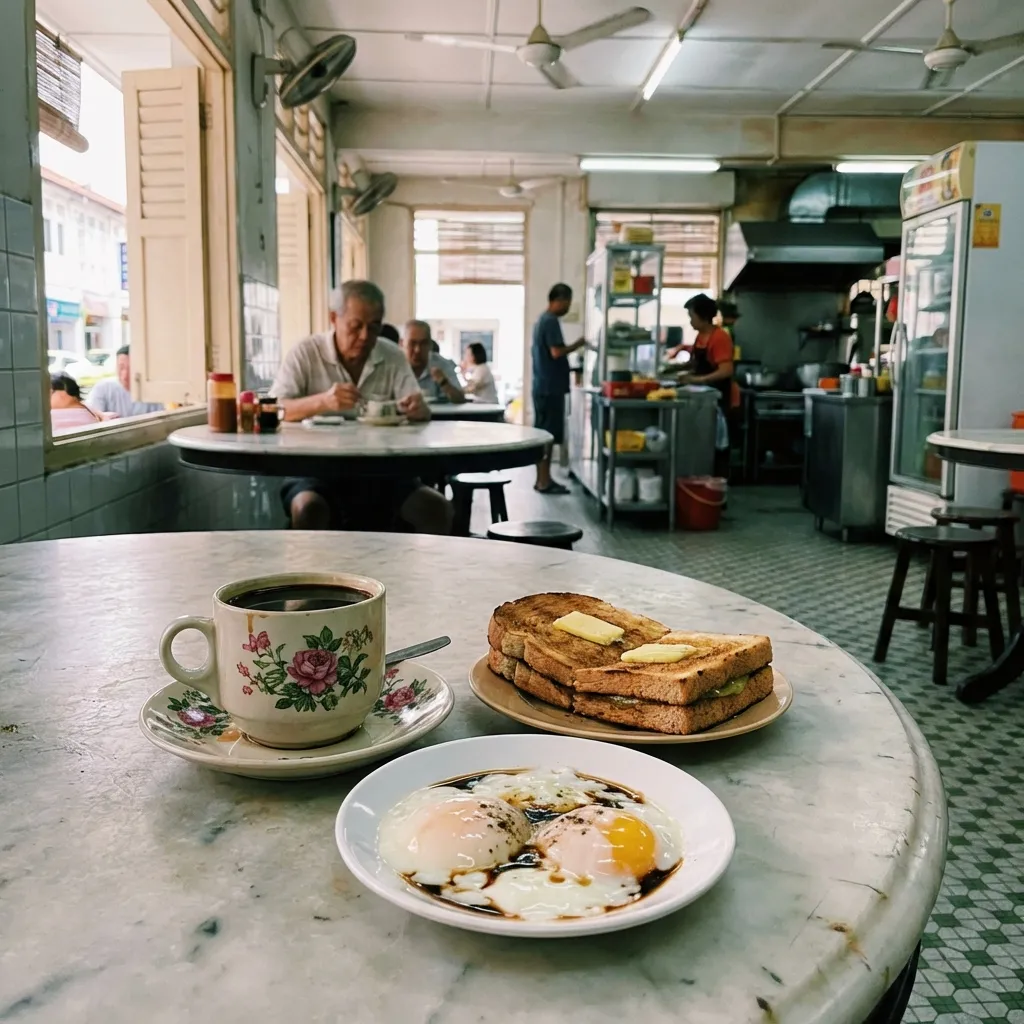
"Don't panic when the uncle asks 'Lim simi?' (Drink what?). Here is the definitive cheat sheet to navigating the complex matrix of Singaporean coffee shop drinks—a linguistic ritual that separates tourists from true locals."
Master Kopi in 5 Points
- 1 Kopi = coffee with condensed milk; Teh = tea with condensed milk—these are your defaults
- 2 O means no milk; C means evaporated milk; Kosong means no sugar
- 3 Siew Dai (less sweet) is the health-conscious choice; Peng means iced
- 4 Order format: Base + Milk modifier + Sweetness + Temperature
- 5 Speak with confidence—the aunties and uncles respect decisiveness
The Complete Modifier Matrix
| Modifier | Meaning | What It Does | Example |
|---|---|---|---|
| O (黑) | 'Black' in Hokkien | No milk, just sugar | Kopi O, Teh O |
| C (淡奶) | 'Fresh' in Hokkien | Evaporated milk + sugar | Kopi C, Teh C |
| Kosong | 'Empty' in Malay | No sugar at all | Kopi O Kosong |
| Siew Dai (少底) | 'Less bottom' | Less sweet (less condensed milk) | Kopi Siew Dai |
| Gah Dai (加底) | 'Add bottom' | More sweet | Teh Gah Dai |
| Gao (厚) | 'Thick' | Extra strong | Kopi Gao |
| Po (薄) | 'Thin' | Weaker brew | Teh Po |
| Peng (冰) | 'Ice' | Iced version | Kopi Peng |
Why Kopi Ordering Is a Rite of Passage
There's a moment every newcomer to Singapore faces: standing at a kopitiam counter, the impatient queue behind them, while an uncle behind the counter fires off a rapid 'Lim simi?' The confident locals rattle off their orders—'Kopi C Siew Dai Peng'—like secret passwords. You freeze. Point at the menu. Feel the collective sigh of the queue.
This isn't just about ordering coffee. This is about belonging.
"My grandmother could order her kopi in her sleep," recalls longtime hawker patron Mr. Tan, 72. "She'd walk up, say 'Kopi Gao' without breaking stride, collect her cup, and be gone. That's style lah."
💡 Practice your order at home before attempting it live. Say it fast, say it confident. The aunties and uncles respect decisiveness.
The kopi ordering system is a beautiful example of Singaporean efficiency—a modular language where you stack terms like building blocks. Master the base, learn the modifiers, and suddenly you're part of the club. This guide will transform you from confused tourist to kopi-ordering pro.
The Base Drinks: Where It All Starts
Every order begins with one of these fundamental bases. Get this wrong, and everything else falls apart.
Kopi (咖啡) - The default. Traditional Nanyang-style coffee made with robusta beans roasted with sugar and butter/margarine, brewed through a cloth sock filter, served with thick, sweet condensed milk. Dark, rich, and unapologetically sweet. This is not your flat white.
Teh (茶) - The same treatment, but with tea instead of coffee. Usually a blend of Ceylon or other black teas, pulled through the sock, served with condensed milk. The tea equivalent of kopi's bold sweetness.
Milo - The chocolate malt drink that Singapore adopted as its own. At kopitiams, it's made with condensed milk (not just water), creating a creamier, richer version than what you'd make at home.
🎯 If you say nothing else—just 'Kopi' or 'Teh'—you will receive the standard version: hot, with condensed milk, regular sweetness. This is your safe default.
"The sock filter is everything," explains veteran kopi uncle Ah Hock, who's been pulling kopi at Tiong Bahru Market for 40 years. "The cloth holds the grounds, but it also holds years of flavour. New sock, the kopi taste different. That's why we never change the sock—we just wash and reuse."
💡 That slightly nutty, caramelised flavour in traditional kopi? That's the butter or margarine used during roasting. It's what makes Nanyang coffee unique.
The Essential Modifiers
Here's where you start customising. These modifiers transform your base drink into exactly what you want. Think of them as audio equalizer settings for your beverage.
O (黑, 'black') - No milk. The drink comes with just water and sugar. 'Kopi O' = black coffee with sugar. The 'O' is from Hokkien for 'black.'
C (淡奶, pronounced 'see') - Evaporated milk instead of condensed milk, plus sugar. Less sweet and creamier than the default. The 'C' comes from Hokkien 'si' for 'fresh' (as in fresher-tasting milk).
Kosong (零, 'empty') - No sugar at all. From Malay for 'zero' or 'empty.' 'Kopi O Kosong' = black coffee, no sugar—the purist's choice.
Gao (厚, 'thick') - Extra strong, more coffee/tea powder used. For those Monday mornings when regular strength won't cut it.
Po (薄, 'thin') - Weaker, less coffee/tea. When you want the ritual without the full caffeine hit.
🎯 The modifier order matters! It's always: [Base] + [Milk Type] + [Sugar Level] + [Strength] + [Temperature]. So: 'Teh C Siew Dai Gao Peng' not 'Teh Peng Gao Siew Dai C.'
"When customer order Kopi O Kosong, I always double-check," laughs auntie Linda. "Some people think they want it, but black coffee no sugar is very bitter one. Then they complain!"
Sweetness Controls
Singaporeans take their sugar levels seriously. Health-conscious locals have developed a precise vocabulary for calibrating sweetness.
Siew Dai (少底, 'less sweet') - Less condensed milk/sugar. The polite way of saying 'I'm watching my sugar intake' without going full kosong.
Gah Dai (加底, 'more sweet') - Extra condensed milk/sugar. When you need that sugar rush or are just feeling indulgent. No judgment here.
Kosong - As mentioned above, zero sugar. Pairs with O or C modifiers for complete control.
"My doctor say must cut sugar," admits regular customer Mdm. Lim, 65. "So now I order Kopi C Siew Dai. Still got the taste, but less guilty lah. Anyway, the uncle here very understanding—sometimes he make it even less sweet than normal Siew Dai. He knows me already."
💡 If you're new to local kopi and find it too sweet, start with Siew Dai. Kosong might be too drastic a jump for taste buds accustomed to milk-based sweetness.
The default sweetness level varies by stall. Some uncles and aunties have a heavier hand with the condensed milk than others. If you've found your regular stall, they'll often remember your preferences—this is the beauty of kopitiam culture.
Temperature: Hot or Iced
Singapore is hot and humid year-round, making iced drinks a necessity rather than a luxury. But here's the thing: hot drinks are still the traditional choice, and many purists insist the flavour is better hot.
Peng (冰, 'ice') - Iced version. Ice is added directly to the drink. 'Kopi Peng' = iced coffee with condensed milk.
(No modifier) - Hot is default. If you don't say Peng, you get it hot.
🎯 Iced drinks are typically made stronger because the ice dilutes the flavour. A good kopitiam will account for this automatically. If your Kopi Peng tastes weak, try Kopi Gao Peng next time.
"Hot weather, of course want cold drink," says Mr. Koh, 58, nursing his Teh Peng at a hawker centre. "But my father always say, hot drink cool you down better—body work to cool the hot liquid, actually feel more shiok after. I still prefer peng though lah."
💡 When ordering Peng, your drink will come in a plastic bag with a straw (traditional style) or in a cup, depending on the stall. Don't be surprised by the bag—it's perfectly normal and quite practical for takeaway.
"The ice matters," notes one kopi stall owner. "Some places use ice that's too big, drink become watery fast. Good stall use crushed ice or smaller cubes—melt slower, flavour stay longer."
The Specialty Orders
Once you've mastered the basics, these specialty orders will really impress the uncles and aunties—and add variety to your daily coffee routine.
Yuan Yang (鸳鸯, 'mandarin ducks') - A magical blend of coffee AND tea in one cup, with condensed milk. Named after mandarin ducks, which symbolise couples in Chinese culture—coffee and tea together forever. The best (or weirdest) of both worlds.
Teh Halia (茶 + halia) - Tea with ginger. 'Halia' is Malay for ginger. Comforting on rainy days (which is most days in Singapore). Often served with condensed milk unless specified otherwise.
Teh Tarik (茶 'pulled tea') - Tea 'pulled' between two cups/mugs to create a frothy top. More common at mamak stalls than traditional kopitiams. The theatrical pulling is half the appeal.
"Yuan Yang is perfect when you cannot decide," explains coffee enthusiast Ms. Chen. "Some days I want coffee, some days I want tea. Yuan Yang says 'why not both?' Very Singaporean logic."
🎯 Teh Halia is excellent for sore throats and when you're feeling under the weather. The ginger adds warmth and supposedly has cooling properties in TCM terms (confusing, we know, but that's traditional medicine for you).
💡 If you see 'Teh Tarik' at a kopitiam, it's often just regular teh served frothy—true tarik-style pulling is more of a mamak stall specialty. Not a huge difference, but purists will note it.
Building Your Order: The Complete Formula
Now let's put it all together. The general formula is:
[Base] + [Milk Type] + [Sweetness] + [Strength] + [Temperature]
Not all modifiers are always used—you only add what you need. Here are real-world examples from simple to complex:
Simple Orders:
• Kopi = Coffee + condensed milk, standard
• Teh O = Tea + no milk + sugar
• Kopi Peng = Iced coffee + condensed milk
Intermediate Orders:
• Kopi C Siew Dai = Coffee + evaporated milk + less sweet
• Teh O Kosong = Tea + no milk + no sugar
• Kopi Gao = Extra strong coffee + condensed milk
Advanced Orders:
• Kopi C Siew Dai Peng = Coffee + evaporated milk + less sweet + iced
• Teh C Gao Peng = Tea + evaporated milk + extra strong + iced
• Kopi O Kosong Gao = Black coffee + no sugar + extra strong
🎯 When in doubt, start simple. 'Kopi C Siew Dai' is the go-to order for many health-conscious Singaporeans—creamy from evaporated milk, but not too sweet. It's a safe, sophisticated choice.
"I keep a cheat sheet in my phone first few months," admits tech worker Priya. "Now can order without thinking. Muscle memory sia."
Kopitiam Etiquette: The Unwritten Rules
Knowing the lingo is half the battle. The other half is understanding the culture around ordering.
Be decisive. Queue behind someone? Know your order before you reach the counter. Hesitation causes traffic jams and earns you impatient stares.
Use the right volume. Kopitiams are noisy. Speak clearly, project your voice. But don't shout—there's a balance.
The tissue paper system. At hawker centres, tissue paper packets on tables mean the seat is 'choped' (reserved). Don't move them; don't sit there. This is sacred law.
Tray return. Since the tray return policy was enforced, clear your own tray. The uncle and auntie will thank you.
"Sometimes the queue so long, people just shout from behind," observes regular Raymond. "That one actually okay—uncle can hear, faster for everyone. But must make sure you queue properly lah, don't just shout and cut queue."
💡 If the stall is busy and you're new to this, it's okay to say 'Kopi' and point at what the person before you ordered. No shame in the learning curve.
🎯 Return your tray with a smile and a 'thank you' to the cleaners. Small gestures matter. And during peak hours, eating quickly and giving up your seat is appreciated—don't camp at a table for hours during lunchtime.
Regional Variations and Quirks
Believe it or not, kopi culture varies slightly across Singapore and Southeast Asia. Here's what you might encounter.
Hawker Centre vs. Cafe - Traditional kopitiams use robusta beans with the butter roasting method. Hipster cafes might offer 'kopi' made with arabica—tasty, but not the same thing at all.
Malaysia's Influence - Across the causeway, 'cham' is used instead of Yuan Yang (coffee-tea mix). Teh tarik culture is also stronger there. Some Johor terms have seeped into Singapore, so you might hear 'cham' occasionally.
The Hainanese Connection - Many traditional kopitiam recipes trace back to Hainanese immigrants who worked in British colonial kitchens and later started coffee shops. That's why kopi culture and Hainanese chicken rice shops often overlap—same heritage.
"My grandfather came from Hainan, work as cook for British family," shares kopitiam owner Mr. Lee. "After war, he start his own coffee stall. Same recipe for 70 years now. We still use original sock and roasting method."
💡 In very old-school kopitiams, you might see 'Kopi Gu You'—coffee with butter. This is rare now but a nostalgic treat for older generations.
"The young people all want oat milk, almond milk," laments one veteran kopi uncle. "I tell them, original is best. But okay lah, I learn to adapt. Some things change, some things stay."
Your First Order: A Step-by-Step Guide
Ready to put theory into practice? Here's exactly what to do on your first real kopi ordering experience.
Step 1: Scout the stall. Find a drinks stall—usually identified by bottles of condensed milk, cans of Milo, and a large thermos or sock-and-pot setup.
Step 2: Queue up. Line up behind other customers. Use this time to finalise your order mentally. No phones—pay attention to the queue.
Step 3: Make eye contact. When it's your turn, the uncle/auntie will look at you. This is your cue.
Step 4: State your order clearly. 'Kopi C Siew Dai, please' or 'Teh O Peng.' Speak with confidence. Smile helps.
Step 5: Pay. Have cash ready (some stalls now take PayNow/NETS, but cash is king). Drinks usually cost $1.20-$2.00.
Step 6: Wait for your drink. Step aside so others can order. Your drink will be ready in under a minute.
Step 7: Enjoy. Proceed to find a seat, or take away in the classic plastic bag. You did it!
🎯 For your very first order, go with 'Kopi C Siew Dai'—it's a crowd-pleaser that most palates enjoy. Or simply 'Teh' if you're a tea person.
"Everyone nervous the first time," reassures auntie Mei Ling, 58. "But we can tell when someone new. We patient lah. Just try your best—got wrong, we correct you. Next time you know already."
💡 If you want extra practice, go during off-peak hours (mid-morning or mid-afternoon) when queues are shorter and the pressure is lower.