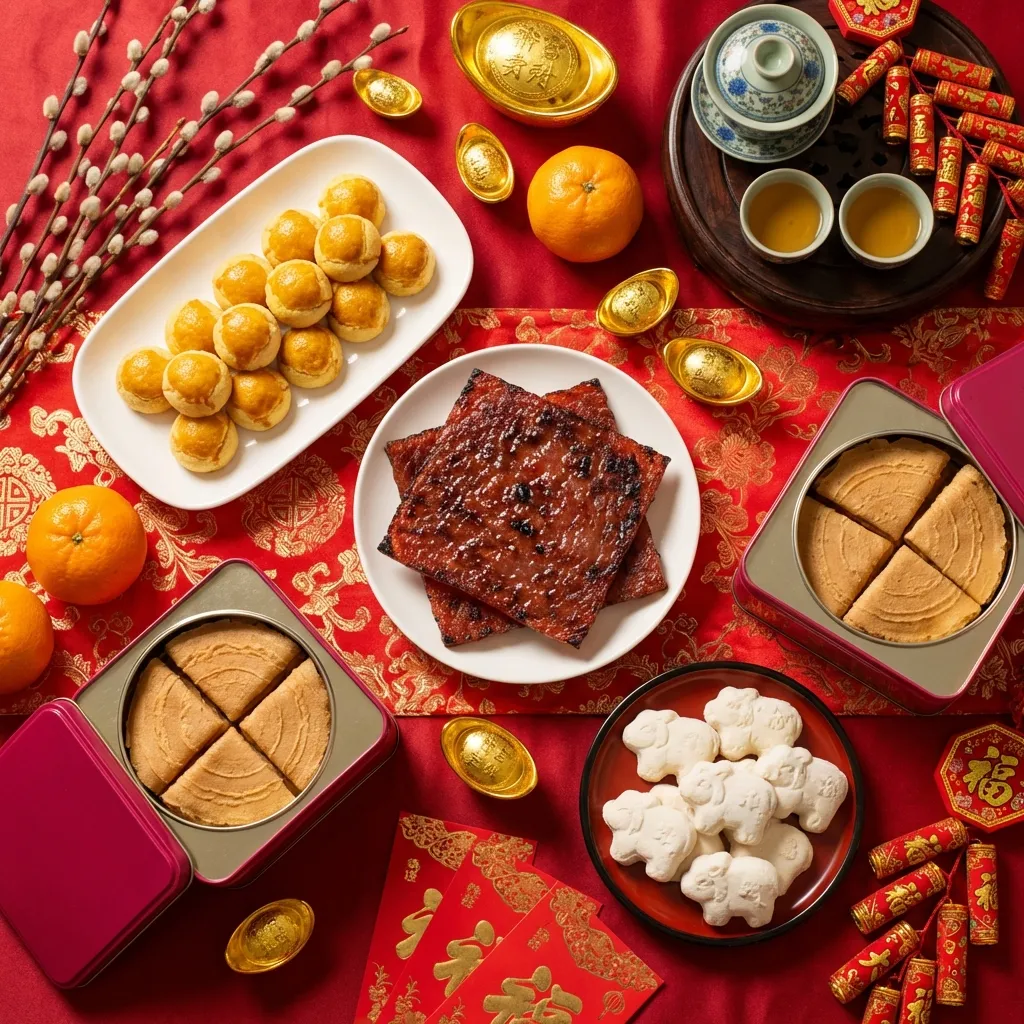
More Than Just Calories: The Meaning Behind CNY Snacks
"Every Lunar New Year, we stuff our faces with pineapple tarts and bak kwa. But these snacks aren't just delicious; they are edible symbols of luck and prosperity."
Quick Summary
- Every CNY snack carries specific symbolism—prosperity, longevity, or family unity
- Pineapple tarts ('Ong Lai') literally mean 'prosperity arrives' in Hokkien
- Presentation matters: red containers, odd numbers, facing the door
- Quality indicators exist for each snack—learn to identify the best
- The tradition continues evolving while core symbolism remains unchanged
CNY Snacks & Their Meanings
| Snack | Symbolism | Lucky Word |
|---|---|---|
| Pineapple Tarts | Prosperity arrives | Ong Lai (旺来) |
| Bak Kwa | Abundance & richness | Red = luck |
| Love Letters | Sweet words, gold bars | Kuih Kapit |
| Kueh Bangkit | Resilience | Bangkit = rise |
| Mandarin Oranges | Gold & good fortune | Kam (金) |
| Nian Gao | Progress yearly | 年高 |
| Melon Seeds | Happiness & fertility | Seeds = offspring |
Snacks That Tell Stories
Chinese New Year isn't just a festival—it's a two-week immersion in edible symbolism. Every snack that appears on your grandmother's coffee table, every treat passed between visiting relatives, carries centuries of meaning. These aren't arbitrary traditions; they're carefully encoded wishes for prosperity, health, longevity, and family unity. Understanding these meanings transforms mindless snacking into cultural participation. When you reach for that pineapple tart, you're not just satisfying a craving—you're literally inviting fortune into your life. TIP: Place snacks in red containers or on red plates during CNY. Red amplifies the auspicious meaning of each treat.
Pineapple Tarts (Ong Lai)
The undisputed king of CNY snacks. In Hokkien, 'Ong Lai' (pineapple) sounds exactly like 'prosperity arrives.' Feeding your guests pineapple tarts is literally wishing that good fortune arrives at their doorstep. The golden colour of the jam resembles gold, doubling the prosperity symbolism. The tart's shape matters too—some families prefer the open-faced 'flower' style that shows off the jam; others swear by the fully enclosed 'pillow' version that keeps fortune 'wrapped up' and protected. "My grandmother would start making tarts three weeks before CNY," shares home baker Serene Loh, 48. "She'd make 500 pieces—for visiting and giving. Her recipe died with her, and I've been trying to recreate it for fifteen years. Still not quite there." The best homemade tarts use fresh pineapple cooked down for hours until jammy, with just the right butter-to-flour ratio in the crust. Store-bought can't compare. PRO TIP: When buying pineapple tarts, check the jam-to-pastry ratio. Premium tarts should have thick, chunky jam, not a thin smear.
Bak Kwa (Barbecued Pork)
A relatively modern tradition that's become inseparable from CNY. Bak kwa emerged because meat was historically a luxury—serving it demonstrated abundance. The red colour is auspicious (red wards off evil spirits and attracts luck), and the sweet-savoury flavour profile represents a life of richness and satisfaction. The pricing system around bak kwa has become its own phenomenon. Prices can triple approaching CNY, and queues at famous shops like Lim Chee Guan stretch for hours. Some people order months in advance. Others queue at 4am on CNY eve. The desperation is real. "I queue for three hours every year at Bee Cheng Hiang," admits civil servant Marcus Tan, 52. "My wife says I'm crazy. But CNY without bak kwa isn't CNY." The texture should be slightly chewy but not tough, with charred edges from the grilling and visible meat fibres. Avoid any that look uniform or processed. TIP: Store bak kwa in the freezer and toast briefly before serving. This restores the just-grilled texture.
Love Letters (Kuih Kapit)
These crisp, rolled wafers have the most romantic backstory of any CNY snack. Traditionally, young lovers would hide notes inside the rolls before giving them to each other—a secret communication method when courtship was closely monitored. Eating them symbolises taking the lover's words into your heart. Beyond romance, their golden cylindrical shape resembles gold bars, making them prosperity symbols as well. The traditional recipe uses coconut milk, eggs, and rice flour, cooked between hot iron moulds over charcoal fire. Making them is an art—too much batter creates thick, chewy letters; too little creates ones that crack and crumble. "My grand-aunt was famous in Kampong Glam for her love letters," recalls Nadira Hassan, 44. "She'd make them over charcoal, turning the mould constantly. The sound, the smell—it was hypnotic. Nobody does it that way anymore." PRO TIP: Real love letters should be paper-thin and shatter when bitten. If they bend, they've absorbed moisture. Store in airtight containers with a silica packet.
Kueh Bangkit
These coconut cookies embody Singaporean duality: hard on the outside, they dissolve instantly on your tongue. They symbolise resilience with adaptability—being tough when needed but knowing when to yield. The shapes carry meaning too: chrysanthemums represent longevity, fish shapes represent surplus ('nian nian you yu'), and sometimes you'll see ingot shapes for wealth. Making kueh bangkit requires serious skill. The tapioca flour must be roasted perfectly, the coconut milk fresh (never canned), and the shaping precise. Undercooked flour makes them dense; over-roasted flour makes them bitter. "I failed at kueh bangkit for five years before getting it right," admits home cook Jenny Tan, 56. "The secret is patience—roasting the flour low and slow for over an hour. Most people give up too early." The best kueh bangkit leaves a whisper of coconut flavour and literally melts to nothing on your tongue. If you have to chew, something went wrong. TIP: Test kueh bangkit quality by placing one on your tongue without biting. Premium ones should dissolve within 3-4 seconds.
Mandarin Oranges (Kam)
The exchange of mandarin oranges is perhaps the most universal CNY tradition. In Cantonese, 'kam' sounds like 'gold,' so giving oranges is giving gold. Always exchange in pairs—two represents 'double prosperity' and togetherness. Never give one (loneliness) or four (sounds like 'death' in several Chinese dialects). The oranges must be inspected before giving. They should be bright orange (not pale), firm (not soft), and ideally still have leaves attached (representing fertility and longevity). Bruised or damaged oranges are inauspicious and should never be exchanged. "My mother inspects every orange before visiting," laughs teacher Amanda Wong, 38. "She rejects half of them. I used to think she was fussy—now I understand. You're giving your hosts their fortune for the year." PRO TIP: Return the same number of oranges you receive to complete the exchange. Never return more or fewer—that changes the symbolism entirely.
Nian Gao (Sticky Rice Cake)
The name says it all: 'Nian' means year, 'Gao' means high or tall. Eating nian gao literally means 'rising/improving each year.' The stickiness also symbolises family togetherness—bound together, unable to separate. Traditional nian gao is made from glutinous rice flour and Chinese brown sugar, steamed for hours until dense and chewy. It can be eaten plain, sliced and pan-fried until caramelised, or sandwiched with taro and yam then deep-fried. Each preparation method has its advocates. "My grandmother's nian gao took 12 hours to steam," shares retired banker David Chen, 65. "She started at midnight so it would be ready for New Year's morning. The modern instant versions are convenient, but they taste like rubber comparison." TIP: Let homemade nian gao rest for 2-3 days after steaming. The texture improves as it firms up slightly.
Melon Seeds & Dried Fruits
The tray of togetherness—that iconic eight-compartment box—always contains melon seeds, red dates, dried longans, lotus seeds, and other dried fruits. Each item symbolises something specific: red melon seeds represent happiness, lotus seeds represent fertility, dried longans represent successful sons, and red dates represent prosperity. The act of cracking seeds is itself meaningful. It requires patience and skill, occupying hands and allowing conversation to flow. The seeds are often dyed red for extra auspiciousness. "My father could crack melon seeds with one hand at incredible speed," recalls food writer Michelle Lim, 45. "It was his CNY party trick. I've never mastered it—I always crush them." The best melon seeds are large, plump, and crack cleanly. Avoid any that feel light (empty inside) or have dusty coatings. PRO TIP: Toast melon seeds briefly in a dry pan before serving. This crisps them up and intensifies the nutty flavour.
Yu Sheng (Lo Hei)
Strictly speaking, yu sheng is a dish, not a snack—but it's become inseparable from CNY celebrations in Singapore and Malaysia. The communal tossing (lo hei) while shouting auspicious phrases is unique to this region. Each ingredient carries meaning: raw fish represents abundance, white radish represents prosperity, green radish represents eternal youth, carrots represent blessings, and the crackers represent wealth scattered like coins. The height of the toss matters—higher tosses bring better fortune. This has led to increasingly enthusiastic (and messy) lo hei sessions in restaurants and homes. "My company's lo hei gets out of control every year," laughs marketing executive Joel Tan, 32. "Last year someone's yu sheng landed on the ceiling fan. Worth it for the luck though." TIP: When tossing yu sheng, shout 'Huat ah!' (prosper) continuously. Silent lo hei is considered bad luck.
Prawn Rolls (Hae Bee Hiam Roll)
Crispy, spicy, and impossibly addictive—prawn rolls are the dark horse of CNY snacks. The filling of dried shrimp ('hae bee') stir-fried with chilli paste ('hiam') represents the fiery spirit needed for success. The rolling of the filling into pastry represents wrapping up good fortune. These snacks showcase Peranakan and Hokkien influences, bridging cultures through flavour. The best versions have a pronounced dried shrimp umami with genuine spice (not just heat). The pastry should shatter completely, leaving no chewy residue. "My Peranakan mother-in-law's prawn rolls are legendary in our family," shares homemaker Sarah Ng, 40. "She makes the filling from scratch—toasting and pounding the dried shrimp herself. It's a three-day process. Nobody else's prawn rolls come close." PRO TIP: Real prawn rolls should smell intensely of dried shrimp before you even open the container. If there's no aroma, the filling is weak.
Egg Rolls & Crispy Puffs
The supporting cast of the CNY snack table deserves recognition. Egg rolls—thin, crispy cylinders—represent gold bars. Crispy prawn or crab puffs represent golden nuggets. Seaweed rolls (nori-wrapped) represent wrapping up good fortune. Arrow-root chips are served because their round shape resembles coins. Together, they create a treasure chest effect on the snack table—abundance made visible. These snacks also serve a practical purpose: they provide variety and prevent palate fatigue. After rich bak kwa and sweet pineapple tarts, the savoury crunch of seaweed rolls refreshes the mouth. "I judge CNY hosting by snack variety," admits food blogger Clement Teo, 36. "If I see the same three snacks at every house, something's wrong. A good host has at least eight different treats." TIP: Arrange snacks in odd numbers (except four) on the table. Odd numbers are considered more auspicious than even numbers in Chinese culture.
The Art of the Snack Spread
How you present CNY snacks matters as much as what you serve. The traditional eight-compartment tray represents completeness (eight is the luckiest number). Red and gold containers amplify prosperity symbolism. Fresh fruits should be placed alongside dried snacks to represent balance. The snack table should face the door so good fortune enters directly. Quantity matters too—running out of snacks during visiting is inauspicious, suggesting your luck will also run out. Experienced hosts over-prepare significantly and send guests home with extra. "My mother calculates snacks per expected visitor, then doubles it," explains finance executive Grace Tan, 48. "Leftover snacks become gifts for the next round of visits. Nothing is wasted, but nothing runs short." The ritual continues to evolve. Modern families might add Western elements—butter cookies, chocolate—but the core symbolism remains. Every sweet, every crunch, every crumb carries wishes for the year ahead.
Make Your Own CNY Treats
Nothing beats homemade CNY snacks. Explore our recipes for pineapple tarts, love letters, and other festive favourites.
Browse Recipes