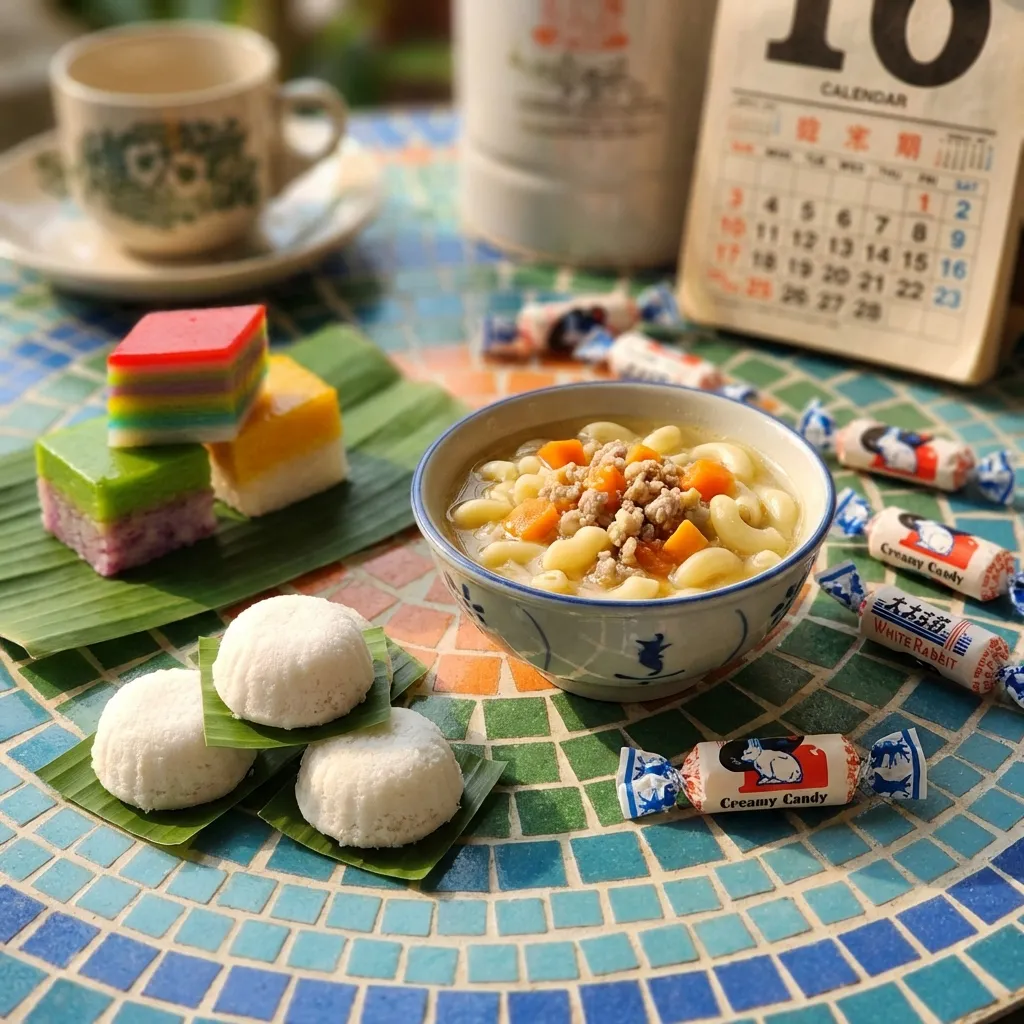
"We asked our community to share the one dish that transports them back to their childhood. Get your tissues ready."
Quick Summary
- Macaroni soup, luncheon meat fried rice, and steamed eggs represent home-cooked love
- Pasar malam treats like tutu kueh created core childhood memories
- School canteen culture—Milo Dinosaur, curry puffs—shaped our social food experiences
- Provision shop treasures like haw flakes and ice gems were playground currency
- Many of these traditions are disappearing—preserving them matters
The Taste of Growing Up
Food and memory are inseparable. The human brain stores taste memories alongside emotional ones, which is why a single bite can transport you decades back in time.
We asked our community to share the dishes that defined their childhoods—not the fancy restaurant meals, but the humble, everyday foods that shaped who they are.
The responses flooded in, and we noticed something beautiful: regardless of race, religion, or neighbourhood, Singaporeans share remarkably similar food memories. These are the dishes that made us.
Macaroni Soup with Minced Meat
Simple, unassuming, and impossibly comforting—macaroni soup was the standard breakfast before school or the guaranteed meal when you were sick.
The magic was in its plainness:
- • Elbow macaroni swimming in clear chicken stock
- • Flecks of minced pork or chicken
- • Maybe some chopped spring onions
- • A dash of white pepper
Nothing more.
"My mum made this every time I had a fever. Now I'm a mother myself, and I make the same thing for my kids. Some recipes don't need improving."
— Rachel Tan, 35
The secret, passed down through generations, lies in using real chicken bones for the stock—not cubes or powder. That gelatin-rich broth coats each macaroni piece with savoury warmth that no shortcut can replicate.
💡 For proper macaroni soup, use a whole chicken carcass boiled for at least 2 hours. The collagen from the bones creates that silky mouthfeel you remember.
Tutu Kueh at the Pasar Malam
The night market was sensory overload for a child—flashing lights, crowds, the smell of frying oil—but nothing captivated quite like the tutu kueh stall.
Watching the uncle (or auntie) pack rice flour into wooden moulds, filling each cavity with ground peanut or gula melaka, then steaming them over a cloth-covered pot was theatrical magic.
The best part? Receiving that fresh white cake, still warm, the filling oozing slightly. Some of us ate them in one bite; others carefully pulled apart each steamed dome to savour the filling separately.
"I still stop at the tutu kueh stall whenever I see one. My kids don't understand the appeal—it's just rice flour to them. But to me, it's every pasar malam of my childhood in one bite."
— Kenneth Lim, 42
The tragedy is that tutu kueh uncles are disappearing. If you find one, support them.
🎯 Fresh tutu kueh must be eaten within 30 minutes. Once cooled, the texture hardens and the magic is lost.
Ice Gem Biscuits & Rabbit Candy
The snacks that defined the playground era.
Ice gem biscuits—tiny golden rounds topped with pastel icing—were currency. You traded them, counted them, ranked their colours. Did you eat the icing first, scraping it off with your teeth? Or did you consume them whole, mixing crunch with sugar? There was no right answer, only fierce debate.
And then there was White Rabbit candy. Those small rectangles wrapped in rice paper sparked endless arguments: do you eat the paper or not? (The correct answer: yes, it dissolves on your tongue.) The slightly chalky, intensely milky sweetness was unlike any other candy. When the wrapper got stuck to the candy inside, you ate it anyway.
"My grandpa always had a tin of White Rabbit candy. We would fight over who got to take the most from his house. Now I can buy them anywhere, but they're not the same."
— Faizah Abdullah, 38
💡 Ice gem biscuits from Khong Guan in the red tin are the nostalgic gold standard. Accept no substitutes.
Rainbow Lapis Sagu
Layer by layer. That was the ritual.
Rainbow lapis sagu—those striped, gelatinous rectangles in pastel colours—demanded to be eaten methodically. You peeled off one layer, ate it, then the next. Some layers were stickier than others. Some colours seemed sweeter. The act of separation was meditative, transforming a simple snack into an extended experience.
These kueh appeared at every birthday party, every family gathering, every school canteen. They were the edible representation of patience and delayed gratification.
"My mother made lapis sagu for every Hari Raya. Ten layers, each a different colour. She would spend hours steaming each layer perfectly. Now she's gone, and I've tried to recreate it, but mine never looks as beautiful."
— Nur Hidayah, 31
The homemade versions, naturally, surpassed all shop-bought alternatives. That subtle coconut flavour and slightly chewy texture came from fresh santan, not canned.
🎯 Real lapis sagu should feel slightly tacky to the touch but not wet. If it's too shiny or firm, it's been made with artificial ingredients.
Fried Rice with Luncheon Meat
Not the fried rice from hawker stalls with their wok hei and professional technique—but the humble version your grandmother made when mum was at work.
The simple ingredients:
- • Cold rice from yesterday's dinner
- • An egg or two, scrambled roughly in
- • Cubes of luncheon meat from the blue tin, crisped slightly on the edges
- • Dark soy sauce for colour, light soy sauce for seasoning
- • Maybe some frozen peas if she was feeling fancy
It was objectively simple, often uneven in texture, occasionally slightly burnt. And yet it tasted better than any restaurant version could hope to.
"My ah ma spoke no English, and I spoke no Hokkien. But she communicated through food. That luncheon meat fried rice was her way of saying she loved me."
— Daniel Chua, 40
The dish represented resourcefulness, practicality, and unconditional love—three pillars of every Singaporean grandmother.
💡 The secret to nostalgic fried rice is using day-old refrigerated rice. Fresh rice is too moist and will turn mushy.
Milo Dinosaur & School Canteen Memories
Before it became a café trend, Milo Dinosaur was a school canteen institution.
That generous scoop of undissolved Milo powder floating on top of an already chocolate-heavy drink was the ultimate indulgence. You learned to time your sips—get some liquid, some crunchy powder, repeat until the cup was empty and you could scrape the remaining sludge with your straw.
School canteen aunties understood children in ways that defied explanation. They knew who needed extra rice, who couldn't handle spice, who was having a bad day.
"The canteen aunty at my primary school always gave me extra curry. Twenty-five years later, I still think about her kindness."
— Priya Menon, 36
The ecosystem of the school canteen—the queues, the bell timing, the rush to favourite stalls—shaped our earliest social experiences around food.
🎯 To replicate childhood Milo, use cold milk (not hot) and don't stir. Add Milo powder on top and eat/drink with a spoon-straw combination.
Potong Ice Cream from the Uncle's Motorcycle
That familiar jingle. The ice cream uncle's motorcycle, with its distinctive horn tune, was the soundtrack of kampong afternoons and HDB void deck evenings.
You'd grab whatever coins you could find and race downstairs, hoping he hadn't moved on.
The legendary offerings:
- • Potong ice cream (durian, red bean, or corn)
- • Bread ice cream sandwiched between rainbow slices
- • Those colourful flower-shaped cups
The durian potong, with its pale yellow interior and slightly icy texture, was divisive—you either loved it or couldn't comprehend why anyone would choose durian when chocolate existed.
"The highlight of my weekend was hearing that ice cream motorcycle. My mother would give us one dollar to share between three siblings. The negotiations over flavours were intense."
— Wilson Goh, 45
These uncle-entrepreneurs are becoming rare, replaced by convenience stores and delivery apps. Some things can't be delivered.
🎯 Real potong ice cream should have ice crystals. If it's too creamy, it's been modernised. The slightly icy texture is part of the experience.
Epok-Epok & Curry Puff from School
The eternal debate: epok-epok or curry puff?
- • Epok-epok (Malay version): fluted crimped edges, spicier filling
- • Curry puff (Chinese-influenced): spiral pastry, sweeter potato curry
Both were perfect; choosing was impossible. School canteens typically had both, and rotating between them was strategic.
"Monday epok-epok, Wednesday curry puff. I still follow this schedule, subconsciously. My colleagues think it's funny."
— Siti Aminah, 33
The best ones had fillings that were just slightly too hot, requiring that awkward open-mouth breathing while refusing to wait. The pastry had to shatter—not bend, not tear, but properly shatter into flaky layers.
Those pre-made frozen versions from supermarkets? They'll never understand. The aunty who fried them fresh, timing them to emerge golden just as recess began? She understood everything.
💡 Fresh curry puffs should be eaten within 10 minutes of frying. That window is when the pastry is at peak crispness.
Haw Flakes, Sng Bao & Provision Shop Treasures
The provision shop (mama shop) was Aladdin's cave for children. Those dimly lit stores, packed floor to ceiling with everything imaginable, held treasures that supermarkets couldn't replicate.
The essentials:
- • Haw flakes—thin, circular discs of hawthorn candy stacked in tubes
- • Sng bao (sour plum candy) in its distinctive packets
- • White Rabbit candy by the handful
- • Those dinosaur-shaped biscuits
- • Mamee noodles eaten straight from the packet, crushed and seasoned
You'd peel each haw flake disc carefully, letting it dissolve on your tongue, that sweet-tart flavour unlike anything else.
"I spent my entire childhood pocket money at Uncle Tan's provision shop. He knew exactly what each neighbourhood kid liked. When the shop closed, I cried."
— Joanne Ng, 39
The provision shop uncle was equal parts businessman, community counsellor, and childhood enabler. He'd give credit to kids whose parents would pay later. He'd warn you if you were spending too much. He saw you grow up.
🎯 Some provision shops still exist in older HDB estates. Support them—they're living museums of childhood.
Steamed Eggs (Zheng Dan) with Rice
When nothing else was in the fridge, there was always this: eggs beaten with water, steamed until silky, drizzled with soy sauce, served over hot rice.
It was the ultimate expression of making something from nothing.
The technique seemed simple until you tried it yourself and produced rubbery scrambled curds instead of that smooth, custard-like texture your mother achieved effortlessly.
"My father worked night shifts and this was his specialty. Three eggs, steamed while the rice cooked. No measuring, no recipe. Perfect every time. I've tried to learn his method for twenty years."
— Jonathan Lee, 44
The dish required no shopping, no advance planning, just eggs and rice—items every Singaporean kitchen always had. It was poverty food that didn't taste poor, comfort food that required no effort to love.
💡 The secret to silky steamed eggs is the ratio—1.5 parts warm water to 1 part egg. Too much water makes it watery; too little makes it dense.
The Recipes We're Losing
Childhood food memories are precious because they're temporary.
The grandmothers who made perfect lapis sagu are leaving us. The tutu kueh uncles are retiring without successors. The provision shops are closing, replaced by 7-Elevens.
This isn't mere nostalgia for nostalgia's sake—it's the recognition that some recipes exist only in the hands that make them.
"I asked my grandmother to teach me her curry recipe before she passed. She couldn't explain it. 'Just agak-agak,' she said. I watched her make it dozens of times and I still can't replicate it."
— Michelle Tan, 37
The challenge for our generation is to document, preserve, and adapt these dishes. Not to freeze them in time, but to ensure they survive in some form.
Your children may never experience the ice cream uncle's motorcycle, but they can experience potong ice cream you've sourced or made. They may never have a provision shop uncle, but they can have you telling them what it meant.
Food memories aren't just made in childhood. They're made every time you cook with intention, every time you share a meal with love.
Share Your Food Memories
What dish transports you back to your childhood? We're always collecting stories from our community. Your memory could be featured.
Share Your Story