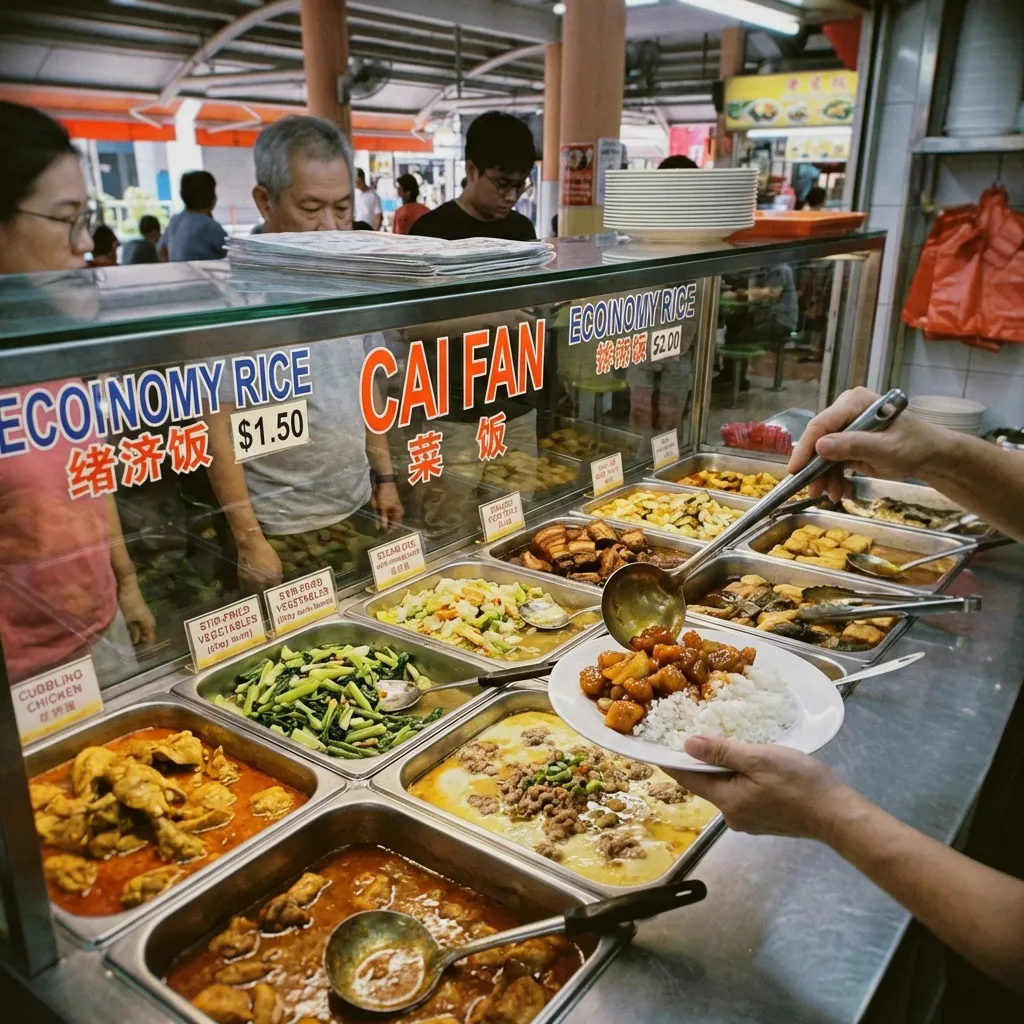
Cai Fan Economics: Maximizing Value at the Rice Stall
"Economy Rice (Cai Fan) is the quintessential Singaporean lunch—but prices can feel arbitrary, portions inconsistent, and that final bill sometimes shocking. Here is how to navigate the rice stall like a seasoned uncle."
Cai Fan Survival Guide
- 1 Point decisively—hesitation is weakness at the cai fan counter
- 2 Assume any dish with meat (even garnish) is priced as meat
- 3 Ask fish prices before ordering to avoid 'market price' shock
- 4 Request gravy (zup) at the end—it's free and transforms your meal
- 5 Become a regular at one stall for better treatment and portions
Understanding Cai Fan Economics
Cai Fan (菜饭, literally 'vegetable rice') is Singapore's great equaliser. Ministers, taxi drivers, students, and retirees all queue at the same counter, point at the same trays, and wonder how their final bill is calculated.
The system seems simple: pick your rice, choose your dishes, pay. But beneath this surface lies a complex pricing matrix influenced by ingredients, portions, the server's mood, and whether you look like you can afford the premium items.
There's no fixed menu. No prices displayed (usually). Just a display of 20-40 dishes and an auntie who calculates your total with algorithmic speed.
"I eat cai fan 30 years," admits regular patron Mr. Lim. "Still cannot predict the price. Same order, different day, different price. But I still come back."
💡 Cai fan prices have risen with inflation. What was $3 in 2015 is now $4.50-5.50. Budget accordingly.
This guide will arm you with strategies to navigate the cai fan experience—maximising value, avoiding traps, and walking away satisfied rather than bewildered.
The Art of Pointing
Communication at the cai fan counter is primarily non-verbal. You point; the server scoops. Words are optional—and sometimes counterproductive.
Point with confidence. A firm, decisive finger says 'I know what I want.' A hesitant, hovering hand says 'I'm easy to confuse.' The server reads body language. If you look unsure, you might get a smaller portion or be upsold to more expensive items.
"Point like you mean it," advises veteran cai fan patron Auntie Linda. "You want the curry chicken? Point straight at the curry chicken. Don't look around, don't second-guess. Point, confirm, next dish."
The pointing sequence matters too. Each dish you select is mentally noted by the server. Changing your mind mid-order causes confusion and slows the line—a cardinal sin during lunch rush.
💡 If you don't know the name of a dish, that's fine. Point at it. If the server asks what you want, just say 'that one' while pointing firmly. Names are unnecessary.
🎯 Make eye contact briefly with the server before pointing. This signals 'I'm ready to order' and establishes your position in the queue clearly.
The Meat vs. Vegetable Trap
This is where most cai fan newcomers get burned. Not everything is priced as it appears.
The fundamental pricing tiers at most stalls are:
1. Pure vegetables (cheapest)
2. Egg-based dishes
3. Tofu and bean products
4. Meat (chicken, pork, fish)
5. Premium items (whole fish, special cuts)
The trap? Many dishes blur these boundaries. Consider:
• Steamed egg with minced pork → Priced as MEAT
• Tofu with minced pork → Priced as MEAT
• Long beans with minced pork → Usually priced as MEAT
• Mapo tofu → Sometimes meat, sometimes veg (depends on stall)
"I order what I think is vegetable dish—bean sprouts," recalls frustrated diner Mr. Tan. "Turns out got a few pieces of char siew inside. Charged me extra $1.50. Now I always check."
🎯 If a dish contains any visible meat—even garnish—assume it's priced as meat. Ask before selecting if budget is a concern.
💡 Pure greens are safest: kangkong, chye sim, spinach, cabbage. These are almost always charged at vegetable rates.
The Fish Price Phenomenon
No cai fan menu item inspires more fear than fish. The words 'Seasonal Price' or 'Market Price' next to any fish item are a warning: you're gambling.
Whole steamed fish (pomfret, seabass, cod) can cost $8-15 per portion—easily doubling or tripling your meal cost. Even fish slices can be surprisingly expensive if they're from premium varieties.
"I order the nice looking fish one time," grimaces office worker Sarah. "Bill come up $14 for one plate cai fan. I nearly die. Now I only order chicken."
The fish price varies based on:
• Type of fish (pomfret vs. batang vs. cod)
• Market prices that day
• Whether it's whole fish or sliced
• The server's judgment of portion size
💡 If you want fish, ask the price before pointing. A simple 'How much ah?' saves shock at the register.
🎯 Fried fish is usually cheaper and more predictable than steamed fish. The portion size is clearer, and the pricing is more standardised.
The Order of Ordering
The sequence in which you point affects what ends up on your plate—and possibly your final bill.
There are two schools of thought:
Theory 1: Meat First
Order your main (meat) dish first. The server places rice in the container, then adds your meat on top—visible, measurable. If you order vegetables first, they form the base layer, and meat gets piled on top obscured by veggies. You can't assess portion size easily.
Theory 2: Cheap to Expensive
Some believe ordering cheaper items first 'sets the tone' for pricing. The server subconsciously thinks 'this is a budget customer' and prices accordingly.
"I always order meat first," insists strategy-minded customer Jason. "I want to see how much chicken they give me. If portion too small, I can ask for more. Cannot do that if it's buried under vegetables."
💡 Regardless of theory, always order rice first. Say 'bai fan' (white rice) or just point at the rice cooker. This signals you're ready to order and starts the plate properly.
🎯 If you want extra rice, ask at the START. Saying 'duo yi dian fan' (more rice) at the end often results in awkward piling. Saying it at the start means the server builds the portion properly from the base.
Gravy is Your Friend
The unsung hero of every cai fan meal is the gravy—and at most stalls, it's free.
'Zup' (汁, sauce/gravy) transforms dry rice into something worth eating. The main varieties:
• Curry zup - Curry gravy, usually chicken or vegetable curry
• Lor zup - Braising sauce, from braised pork belly or duck
• Dao you - Soy sauce (basic but effective)
• Cai zup - Vegetable gravy (whatever's leftover in the veg trays)
Ask for gravy at the END of your order, after all dishes are on the plate. The server will pour it over the rice, flavouring every bite.
"Curry zup is free? Of course I want!" exclaims student diner Marcus. "That's like $0 for extra flavour. Always take."
Some stalls are more generous than others. A good cai fan stall ladles gravy liberally; a stingy one gives a miserly drizzle. The generosity of the gravy is often a sign of overall stall quality.
💡 You can ask for multiple gravies if you're feeling adventurous. 'Curry and lor zup both can?' Most servers will oblige.
🎯 If the stall has braised pork belly (lor bak), the lor zup is liquid gold. That rich, star anise-scented sauce elevates plain rice to something special.
Know Your Value Items
Not all cai fan dishes offer equal value. Over years of observation, certain items have emerged as consistently good deals—and others as traps.
High Value (Good Portion to Price Ratio):
• Braised pork belly (lor bak) - Rich, flavourful, usually generous
• Curry chicken - Sauce is half the appeal, portions tend to be fair
• Fried egg - Cheap protein, hard to mess up
• Stir-fried vegetables - Filling, healthy, budget-friendly
• Steamed egg - Silky texture, underrated option
Low Value (Often Disappointing):
• Steamed fish - Expensive, portion unpredictable
• Sweet and sour pork - Mostly batter, little meat
• Deep-fried items - Filling space with air, not food
• Pre-made salads - Often stale, overpriced
"The braised pork belly at my regular stall—always worth it," confirms regular Mr. Koh. "Big pieces, fatty, delicious. Sweet and sour pork? All batter. Skip."
💡 Dishes that sit in liquid (curries, braised items) tend to be more generous because the sauce adds volume. Dry dishes are measured more stringently.
🎯 Look for dishes that are still being replenished. Fresh batches mean better quality. If a tray looks depleted and scraped, the portions will be smaller.
The Two Meat, One Veg Formula
If you want a satisfying meal without breaking the bank, the classic formula is two meats and one vegetable—or one meat and two vegetables if you're watching your budget.
Budget Meal (Approx. $4-5):
• 1 meat dish (chicken, pork)
• 2 vegetable dishes
• Request gravy
Standard Meal (Approx. $5-6.50):
• 2 meat dishes
• 1 vegetable dish
• Request gravy
Indulgent Meal (Approx. $7-9):
• 2-3 meat dishes (including one premium)
• 1 vegetable dish
• Request gravy
"I stick to two meat one veg for work lunch," explains civil servant Amanda. "Fills me up, doesn't break the bank, and I can predict the price within $1."
💡 Adding a third vegetable is usually cheaper than adding a third meat. If you want volume, go for veggies.
🎯 Some stalls have a 'same price for 3 items' system—all items are priced individually regardless of what they are. At these stalls, load up on meat. Other stalls price by category, so strategy matters more.
Reading the Stall
Not all cai fan stalls are equal. Before committing to a queue, survey your options.
Signs of a Good Stall:
• Steady queue of regulars (not tourists)
• Food being replenished frequently (fresh batches)
• Large variety of dishes (suggests high turnover)
• Clean trays and organised display
• Server who moves efficiently
Signs of Trouble:
• Empty trays not being refilled
• Food looking dried out or crusty
• Very short queue during peak hours (why is no one eating here?)
• Server who seems confused or slow
• Prices posted (sometimes indicates tourist-trap pricing)
"I only eat at stalls with queue," says quality-conscious diner James. "No queue, something wrong. Either food not nice or prices too high."
💡 Visit a new stall during off-peak hours first. You'll have time to survey the options and ask questions without line pressure.
🎯 Watch how the server interacts with regulars. If there's friendly banter and relaxed service, that's a well-run stall with loyal customers.
Peak Hour Survival
Lunchtime at a popular cai fan stall is controlled chaos. The queue snakes, the servers shout, and hesitation is not tolerated. Here's how to survive.
Before Joining the Queue:
• Survey the display from a distance. Identify what you want BEFORE getting in line.
• Have your payment ready. Cash in accessible pocket; PayNow app open.
• Mental rehearsal: know your order, visualise pointing sequence.
In the Queue:
• Don't chat on phone or check messages—pay attention.
• Watch the server's rhythm. When it's your turn, act immediately.
• If someone asks 'ordering?' respond quickly or let them pass.
At the Counter:
• Point decisively. Don't pause. Don't change your mind.
• If the server didn't catch your selection, point again, don't explain verbally.
• Accept your plate, pay, move out of the way.
"Lunch hour is battlefield," describes IT worker Ryan. "No time to think. If you think, you lose. Know what you want, get in, get out."
💡 If the queue is too long, consider coming back at 1:30pm or 2pm. The rush dies down, and you might get better portions from fresher batches.
🎯 Regular customers at popular stalls often have their 'usual' order memorised by servers. If you become a regular, life gets easier. The server sees your face and starts preparing before you even point.
The Price Negotiation Myth
Can you negotiate cai fan prices? The short answer: not really. But you can influence outcomes.
Unlike wet markets where haggling is expected, cai fan pricing is the server's domain. They calculate, you pay. Arguing about prices is considered poor form and will likely result in smaller portions next time.
However, you CAN:
• Ask prices before selecting ('How much ah, this fish?')
• Request larger portions politely ('Can give a bit more?')
• Build a relationship so you become a 'regular' with favourable treatment
• Express gratitude, which sometimes earns goodwill
"I never argue price," explains regular patron Auntie Lim. "But I always smile, always say thank you. After a while, auntie recognise me, give me bigger portion. Same price, more food. That's real negotiation."
💡 If you genuinely think you've been overcharged (it happens), ask politely and privately—not at the counter with a queue behind you.
🎯 The best 'negotiation' is frequency. Eat at the same stall regularly, at the same time, and order consistently. Within weeks, you'll be a familiar face. Familiar faces get treated well.
Cai Fan Etiquette
Finally, some unwritten rules that keep the cai fan ecosystem functioning smoothly:
Do:
• Queue properly. No cutting, no 'choping' spots for friends.
• Have payment ready. Don't dig through your bag after the bill is calculated.
• Return your tray. It's the law now, but it was polite even before.
• Say thank you. A simple 'xie xie' or 'thanks auntie' costs nothing.
Don't:
• Don't touch the dishes yourself. Point, don't grab.
• Don't block the queue while deciding. Step aside if you need time.
• Don't complain loudly about prices. Quiet acceptance or quiet departure.
• Don't take photos that slow down the line. Instagram can wait.
"The auntie work hard all day," reminds social etiquette observer Mdm. Tan. "Hot kitchen, standing for hours. Be patient, be polite. They remember who is nice and who is rude."
💡 If you have dietary restrictions (halal, vegetarian, allergies), ask clearly at the start. Most servers will accommodate—but they need to know upfront.
🎯 Compliment the food if it's good. A genuine 'wah, today's curry very nice' will make the server's day—and might earn you extra gravy next time.